Responsible culture:
Our suppliers
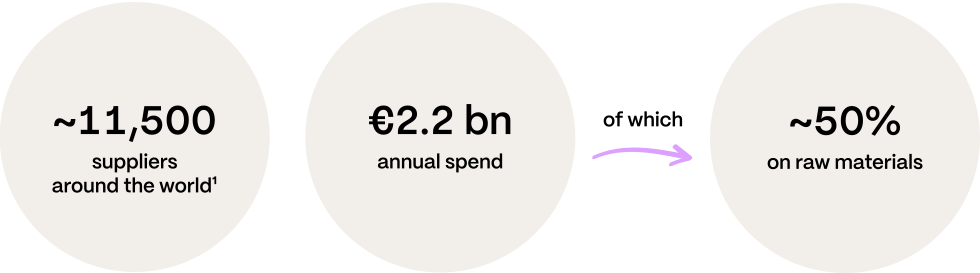
Our suppliers play a vital role in the success of our ambition for a regenerative and just transition.
We expect our suppliers to uphold high standards in ethics, labor practices, health and safety and environmental stewardship – reflecting the expectations of our customers and investors.
Sourcing raw materials sustainably is essential to ensuring a reliable supply for our customers today and in the future, and directly supports our Nature+, Resource+ and Climate+ commitments. By prioritizing materials certified to the highest responsible sourcing standards, we strengthen the environmental credentials of our packaging and advance our sustainability goals.
Our commitments
We are committed to engaging with suppliers to drive systematic change and support regenerative practices, including the promotion of human rights.
Our approach
Measures taken and responsibilities
Chief Supply Chain Officer
We have taken concrete steps to embed ethical, environmental, and human rights considerations across our supply chain. Through robust due diligence, supplier engagement and internal training, we are building a more transparent and resilient sourcing model that supports regenerative practices and respects human rights.
100% of our significant suppliers1 to have signed our Supplier Code of Conduct or have an equivalent code for respecting human rights in place, by 2030
Ensure 50% of our significant suppliers1 will have participated in Human Rights training, by 2030 (from 2026)
Provide regular training (at least every two years) on ethical supplier standards and sustainable sourcing to all employees who interact frequently with suppliers, by 2030
We ensure sourcing of A-materials2 from certified and responsible sources, in line with our Responsible sourcing commitment in Nature+.
Our Supplier Code of Conduct sets out our expectations on topics such as human and labor rights, health and safety, corruption and bribery and environmental protection. Suppliers are expected to communicate and apply the principles throughout their supply chain, supporting compliance with human rights due diligence regulations.
A risk assessment is conducted for all suppliers using the EcoVadis IQ platform to screen against social, environmental and governance criteria which considers the business relevance of the supplier and available supplier data as well as country and industry risk data.
Our 246 significant suppliers undergo additional due diligence on responsible sourcing requiring formal acceptance of our Supplier Code of Conduct at a minimum, and monitoring compliance through risk performance assessments.
We encourage suppliers to undergo third-party assessments, such as SEDEX Members Ethical Trade Audits or EcoVadis. Criteria for our audits of high-risk suppliers include human and labor rights.
We require equipment suppliers providing parts for our filling machines to comply with all applicable laws and regulations related to conflict minerals from conflict-affected or high-risk areas.
We ask all equipment suppliers to complete a survey on critical and sustainable raw materials and all relevant suppliers to our conflict minerals due diligence process to complete a Conflict Minerals Reporting Template (CMRT).
Statements made on conflict-free sourcing in supplier surveys and CMRTs by equipment suppliers are validated against EcoVadis industry definitions of potential conflict minerals, and where incomplete, are remediated with the supplier through corrective actions.
Our sourcing category leads provide training to, and conduct internal audits of, the Accounts Payable department to ensure traceability and accuracy of certification claims on supplier invoicing.
We maintain an Integrity and Compliance Hotline which extends beyond our own operations to our suppliers’ business activities. For further details see Responsible culture: Our people.
Our responsible sourcing directives, and accompanying training, provide procurement teams with detailed guidance on how to implement our responsible sourcing approach.
Senior management is provided with additional training on responsible procurement from the EcoVadis Academy.
A-materials are the key raw materials used in our packaging, and we prioritize sourcing them from sustainable sources. To mitigate human rights and ESG (environmental, social, and governance) risks, we separately identify significant suppliers – this may include A-material suppliers – based on their potential impact and relevance.
1 See how we define our significant suppliers.
2 See How we define our A-materials.
How we define our significant suppliers
In 2025, we have updated our approach on how we identify significant suppliers for our packaging, focusing our efforts on higher risk suppliers where we can drive a bigger change to supplier responsibility.
Significant suppliers are those identified through EcoVadis IQ Plus as having elevated human rights and environmental, social and governance risks, taking into account factors such as overall risk level, regulatory relevance, their business relevance to SIG (e.g. supply chain due diligence), and priority for action on issues such as modern slavery.
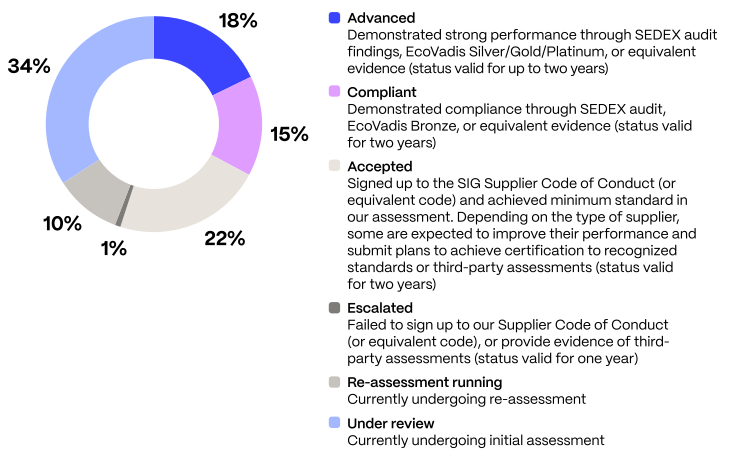
Rating significant suppliers on responsible sourcing standards
How we define our A-materials
A-materials are the raw materials that go directly into our packs.
Aseptic cartons
paperboard, polymers, films, aluminum foil, ink and solvents
Chilled cartons
paperboard, polymers, ink and solvents
Bag-in-box and spouted pouches
polymers and films
SIG does not manufacture or sell the cardboard box of our bag-in-box solutions.

Where our A-materials come from
We source the main1 A-materials for our packs from around 150 suppliers – ranging from local paper mills that source wood from their own forests to major multinational mining and chemical companies.
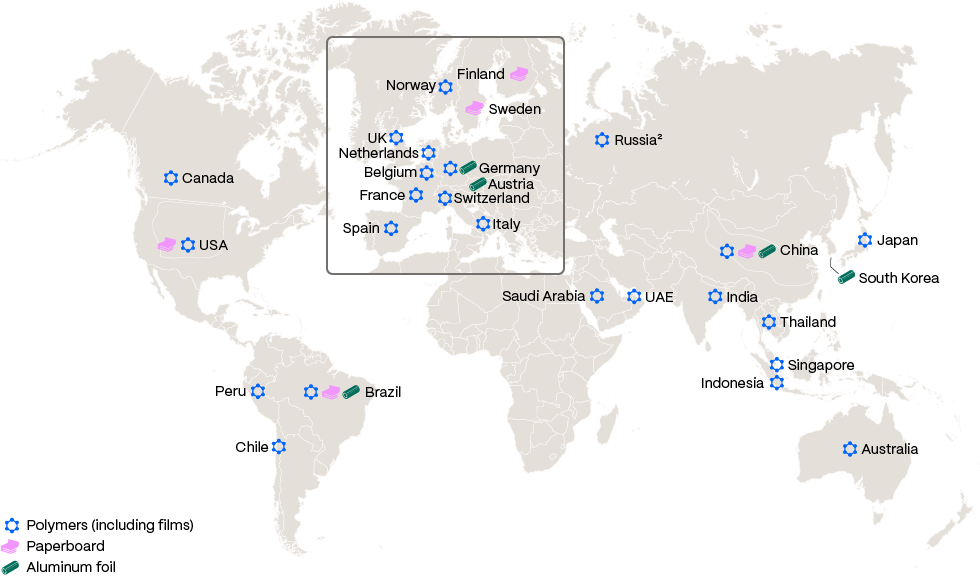
1Excludes inks and solvents which we source in negligible volumes compared to our other A-materials.
2This relates to one local polymer supplier that only provides polymers to our production plant in Voronezh, Russia. The supplied volume corresponds to approximately 0.1% of the global polymers volume purchased by SIG.
Assessing effectiveness
In addition to the performance assessment of our Resource+ targets and Key performance indicators we assess the effectiveness of our policies and actions through the below reporting and monitoring by responsible parties:
Reporting |
|
Department |
|
Responsible |
|
Regularity |
|---|---|---|---|---|---|---|
Significant supplier responsible sourcing status |
|
Global Sourcing and Procurement |
|
VP Global Sourcing and Procurement |
|
Quarterly |
Our targets and performance
2020 to 2025 targets and performance
Target |
|
Material topics |
|
Progress tracker |
|
2025 performance |
|
Next steps |
||||||
|---|---|---|---|---|---|---|---|---|---|---|---|---|---|---|
Ensure 100% of significant suppliers1 accept our Supplier Code of Conduct or have an equivalent code in place |
|
|
|
|
|
65% of our significant suppliers1 accepted our Supplier Code of Conduct or have an equivalent code in place. |
|
Retained in our Responsible culture: Our suppliers commitment. |
||||||
Audit 50% of high-risk significant suppliers each year |
|
|
|
|
Under our previous definition of significant suppliers, we identified three suppliers (representing less than 1%) as high-risk2 through self-assessments in 2024. One supplier has accepted our Supplier Code of Conduct in the meantime and an audit for another supplier is planned for early 2026. We are continuing discussions with the third supplier to obtain sufficient information and decide on next steps. |
|
Our updated definition of significant suppliers, coupled with the related code of conduct target, will allow us to better incorporate all potential risks. |
|||||||
Provide regular training (at least every two years) on ethical supplier standards and sustainable sourcing to all employees who interact frequently with suppliers |
|
|
|
|
|
We provided training for all global, regional, and local procurement teams in 2025. |
|
Retained in our Responsible culture: Our suppliers commitment. |
||||||
|
||||||||||||||


See Appendix: Key performance indicators for related key performance indicators.
2026 to 2030 targets
Target |
|
Material topics |
|
2025 performance |
||||
|---|---|---|---|---|---|---|---|---|
Drive systematic change and support regenerative practices |
||||||||
100% of our significant suppliers1 to have signed our Supplier Code of Conduct or have an equivalent code for respecting human rights in place, by 2030 |
|
|
|
65% of our significant suppliers1 accepted our Supplier Code of Conduct or have an equivalent code in place. |
||||
Ensure 50% of our significant suppliers1 will have participated in Human Rights training, by 2030 |
|
|
|
Reporting from 2026 |
||||
Provide regular training (at least every two years) on ethical supplier standards and sustainable sourcing to all employees who interact frequently with suppliers, by 2030 |
|
|
|
We provided training for all global, regional, and local procurement teams in 2025. |
||||
|
||||||||
See Appendix: Key performance indicators for related key performance indicators.
Outlook
Fostering responsible suppliers is an ongoing journey that requires continuous improvement and collaboration, in line with evolving global expectations for supply chain transparency and accountability.
We believe our updated targets and significant supplier definition will help us to support suppliers with the greatest potential for change to adopt regenerative practices and uphold the highest standards. Internally, we are expanding the continuous training of our staff and the application of our Responsible Supplier and Sustainable Raw Material Directives to bag-in-box and spouted pouch filling machine suppliers, empowering our employees to become drivers of change.