Our sustainability governance
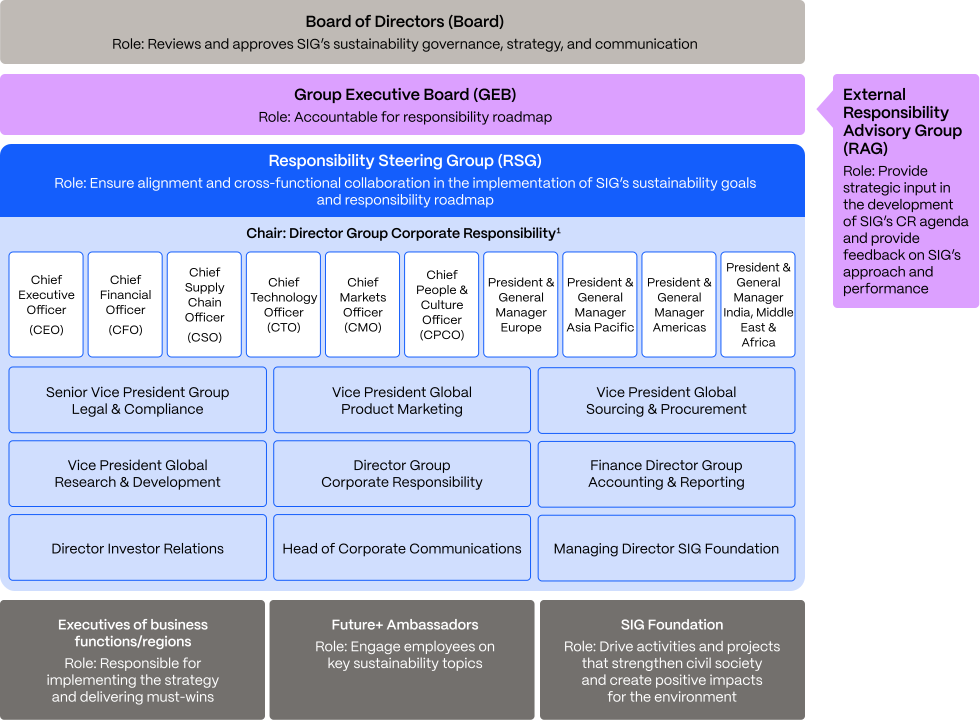
The Board of Directors (Board) reviews and approves SIG’s sustainability strategy, governance, and reporting, including the annual sustainability reporting. The Board’s Nomination and Governance Committee (NGC) oversees the Company’s strategy and governance on corporate responsibility for environmental, social and governance (ESG) matters, in particular, key issues that may affect the Group’s business and reputation, including climate and nature-related risks and opportunities. The NGC advises the Board on such matters.
The Group Executive Board (GEB) is accountable for the responsibility roadmap, and along with the Board, receive regular updates regarding the Group’s sustainability initiatives and Environmental, Social and Governance (ESG) performance. This ensures that the Board maintains oversight of these matters and key performance indicators (KPIs) that are relevant to the Group’s business. The Director Group Corporate Responsibility provided the Board with an annual update where they approved our refocused strategy and targets.
The Audit and Risk Committee (ARC) reviews and discusses the Group’s sustainability reports with management and, to the extent applicable and relevant, with the Group’s assurance providers. It monitors the Group’s performance against the Group’s sustainability KPIs. It also makes recommendations to the Board on the Group’s public reporting on ESG matters. The Director Group Corporate Responsibility provides an update to the ARC on an annual basis.
In 2024, we briefed the Board on the strategic evolution of SIG’s sustainability approach, including our transition toward regenerative packaging solutions. Following this engagement, the Board formally endorsed the revised commitments and targets in 2025, as outlined in this report. The ARC was also updated on the risk and governance implications of these changes.
Ultimate accountability for the Group’s ESG performance and progress lies with the CEO and the GEB. This accountability is underpinned by an ESG-related element incorporated in the GEB members’ Short-Term Incentive Plan. GEB meetings cover, where relevant, items on sustainability and ESG topics. The GEB approves the Group’s annual sustainability report before approval by the ARC and ultimate approval by the Board.
GEB members are part of the Responsibility Steering Group (RSG), which also includes other senior representatives of key functions. The RSG meets twice a year to review strategic proposals and progress and ensure alignment of ESG-related work across the company.
Each focus area of the Group’s sustainability approach, including the related commitments outlined in our policies, is owned by a member of the RSG, who is accountable for setting goals and delivering progress through targeted workstreams. Leaders from relevant business functions and regions are responsible for implementing the Group’s sustainability commitments, with support from their teams and subject matter experts.
We publish our policies on ESG topics to clearly set out our commitments and targets, except for certain internal policies such as our anti-bribery and anti-corruption policy. Accompanying in-depth internal operating procedures support effective implementation across the business. Employees are provided with training on topics relevant to their role. We also strive to inform and engage all our people on sustainability, with support from our network of Future+ Ambassadors. As part of the SIG Academy, 12 e-training modules on sustainability have been launched and are available to all employees. Interactive webinars on sustainability were also delivered as part of our Upskill sessions, to further build awareness on sustainability topics.
The SIG Foundation also supports our ambitions through targeted charitable projects and partnerships that strengthen civil society and create positive impacts for the environment. Members of the leadership team sit on the SIG Foundation’s Board of Trustees.
For more on the SIG Foundation and an overview of its activities in 2025, see Responsible culture: Communities.
Due diligence approach
The Group applies a due diligence approach to address environmental matters, social matters, employee-related matters, human rights and anti-corruption. Relevant impacts, risks and opportunities are regularly assessed and policies implemented and regularly updated. The policies define commitments and targets, as well as measures (implementation approach) and responsibilities in relation to these matters. Measures in place are aimed at reducing negative impacts or increasing positive impacts, where possible.
Measurement and effectiveness
The Group has different management approaches in place to implement measures and ensure their effectiveness. The Group defines KPIs in relation to various matters such as environmental matters, social matters, employee-related matters, human rights and anti-corruption which are regularly reviewed and help us to also quantitatively assess effectiveness and performance over the years against targets. In cases of a negative development of KPIs or in cases of non-achievement of targets, counter measures can be taken, or measures may be adjusted to enhance effectiveness.
Specific measures can be found in our Climate+, Nature+, Resource+, Food+ and Responsible culture: Our people, Our suppliers and Communities sections.
The responsibility and accountability of the sustainability commitments and targets have been allocated to sponsors from the GEB to ensure robust integration into the business functions and alignment throughout the organization. Details of the responsibilities are outlined throughout this Annual Report.

SIG sustainability governance structure
Integrating external insight
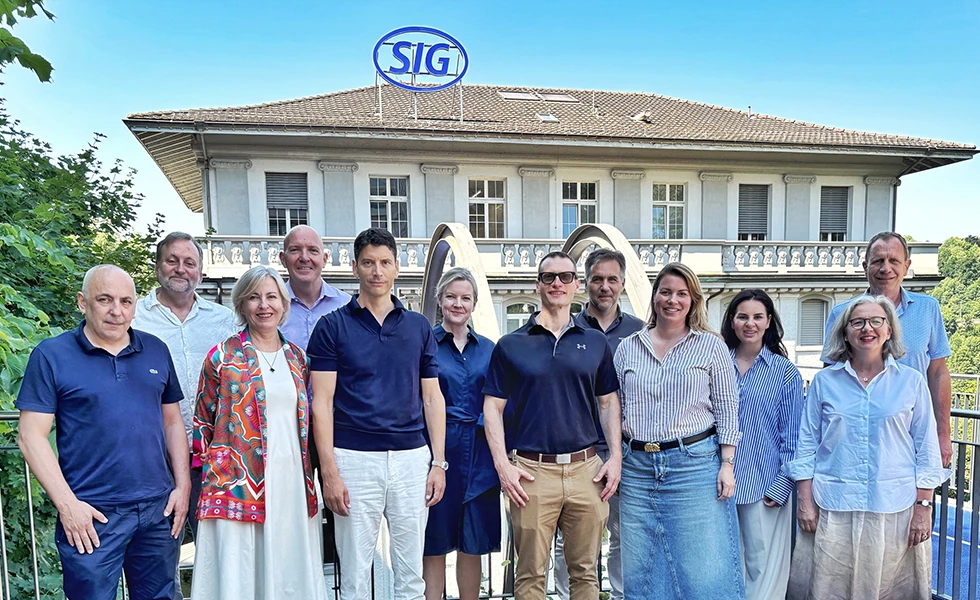
Members of the GEB meet twice a year with our independent Responsibility Advisory Group (RAG), a group of external experts who provide strategic input to the RSG and GEB and challenge us to improve.
In 2025, the RAG helped shape SIG’s strategic refocus toward a regenerative packaging system, aligning on a clear set of commitments and targets that respond to escalating global sustainability challenges. Recognizing the need for systemic change, the RAG supported SIG’s integrated approach across Climate+, Resource+ Nature+, Food+ and Responsible culture, and emphasizing innovation as a key driver of this change. Members acknowledged that SIG’s impact extends beyond packaging, contributing meaningfully to broader environmental and social goals.

SIG’s goal to build a regenerative food packaging system is a major step forward. The focus on restoring ecosystems and improving forest landscapes respects the link between packaging and nature, and how that link can be harmful but can also be beneficial. It’s encouraging to see investments in biodiversity preservation and partnerships such as WWF. Combined with science-based climate targets and a clear Scope 3 strategy, SIG continues to walk the talk of pursuing systemic change. The approach maintains SIG’s leadership in integrating nature-positive outcomes with business goals. Scaling these efforts will require persistence and collaboration, and SIG has good track records on both of those as well. And I believe that employee engagement on these topics can provide an extra lever to turn ambition into action.
Greg Norris (RAG Chair)
Co-Director of the Sustainability and Health Initiative for NetPositive Enterprise (SHINE)

A global vision must translate into solutions that work locally and address customer challenges. SIG’s focus on renewable materials, paperization, and aseptic technology aligns innovation with customer needs and consumer expectations for safe, sustainable products. These solutions also support nutrition and health goals. The four action areas – Nature+, Resource+, Climate+, and Food+ – provide a framework for systemic change, but success depends on practical outcomes and partnerships. Regional differences mean collaboration with customers and local stakeholders is essential.
Gail Klintworth
Chair, Non-Executive Director, and (Board) Advisor: Rabobank, Shell Foundation, MAS Holdings, Globescan, Takeda Pharmaceuticals, Al Dabbagh Group, Savo Project Developers

Capital markets reward companies that combine sustainability with growth. SIG’s strategy update aligns with global trends and creates business opportunities. Its priorities increasingly support customers’ ESG goals and regulatory compliance. Progress in formats like bag-in-box and spouted pouch strengthens competitive advantage, while aseptic technology offers benefits as regulations tighten – safe distribution without preservatives. Companies leveraging these shifts will be well positioned for growth. SIG’s science-based targets signal resilience and long-term value creation.
Matt Sherwood
Chief Executive Officer Pothos Partners & Chief Investment Officer for the Pothos Climate Fund

The era of commitments without clear pathways is over – credible transition plans matter. SIG’s net-zero roadmap, backed by science-based targets, reflects this shift. At the same time, partnerships like WWF’s Forests Forward program deliver real impact by restoring forests, protecting biodiversity, and engaging communities. These actions can trigger systemic change. Transformation must accelerate exponentially, not progress linearly. SIG’s strategy shows an understanding of this dynamic and a willingness to lead on climate and nature.
Thomas Vellacot
Chief Executive Officer, WWF Switzerland

Building a regenerative packaging system is about people: employees, customers and consumers as much as technology.
Companies that succeed, attract the right talent, anticipate consumer expectations for sustainable, safe, and easy-to-use packaging as they respect our natural environment. SIG definitely embeds sustainability into its core business and drives innovation in recyclability, renewable materials, reducing plastics, responding to the needs of emerging food and health trends. These milestones meet both environmental goals and market demands. Preparing for future trends, such as Gen Z expectations, will require greater collaboration across regions and systems: SIG is well positioned to lead on both people and innovation.
Véronique Cremades-Mathis
Independent Board Director at Terracycle, The Pure Food Co and Executive Director at Mathis Consulting