Climate+
We aim for climate-positive packaging by designing solutions that actively reduce emissions and remove carbon, and commit to decarbonizing our value chain in line with climate science, while enabling carbon emission savings beyond our value chain.
To achieve this, our focus within our value chain lies on:
Accelerating decarbonization through the use of renewable, low carbon and regenerative materials across all packaging formats and the whole value chain.
Phasing out fossil-based inputs by shifting to bio-based alternatives and renewable energy throughout the value chain.
Enabling circularity as a complementary strategy such as keeping materials in use longer to further reduce carbon emissions and resource extraction.
Paving the way to capturing carbon inside the SIG value chain in view of the role nature and forest can play.
Beyond our value chain we focus on:
Helping customers and consumers reduce food loss and waste.
Helping customers and consumers to use packaging with a significantly lower carbon footprint than conventional alternatives1 in the segments we serve.
Through this approach, our packaging will go beyond minimizing impact. It will actively contribute to decarbonizing the food distribution system and deliver positive climate outcomes inside and outside our value chain.
1 See Our sustainability approach for details of our packaging life-cycle assessments.
Our targets and climate transition plan – which address both physical and transition-related risks, outline mitigation and prevention measures, and identify opportunities – are comparable with Swiss climate goals as set out in the Swiss Climate Protection Ordinance and the Climate and Innovation Act. See our TCFD report, the Key performance indicators, and the Greenhouse gas emissions basis for reporting in the Appendix.
Our commitments
We will drive the transition to a regenerative packaging solution that will help to remove more carbon than is emitted for production. We will achieve this in line with our 2050 Net Zero value chain commitment, with clear and ambitious SBTi-approved targets, sub-targets and collaborative actions:
Decarbonizing our operations: As near-term targets, SIG commits to reduce absolute Scope 1 and 2 greenhouse gas emissions by 42% by 2030 from a 2020 base year and to continue annually sourcing 100% renewable electricity through 2030. And as a long-term target, SIG commits to reduce absolute Scope 1 and 2 greenhouse gas emissions by 90% by 2050 from a 2020 base year.
Decarbonizing our value chain: SIG further commits to reduce Scope 3 greenhouse gas emissions by 51.6% per liter packed by 2030 from a 2020 base year. SIG also commits to reduce Scope 3 greenhouse gas emissions by 97% per liter packed by 2050 from a 2020 base year.
SIG is also committed to reducing climate impacts beyond our value chain by helping our customers and consumers reduce their carbon footprint.
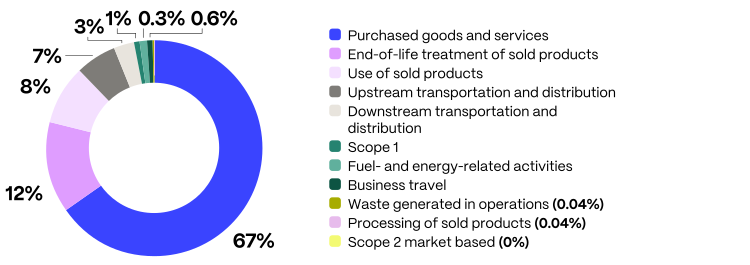
SIG Group emissions
by category in 20251
Our approach
Measures taken and responsibilities
Decarbonizing our operations
Chief Supply Chain Officer
Eliminating fossil-based inputs will accelerate our own operational decarbonization and support our efforts to deploy a regenerative packaging solution. The following targets are driving the decarbonization of Scope 1 and 2 greenhouse gas (GHG) emissions of 42% by 2030 (from 2020).
Reduce 42% of our absolute Scope 1 emissions, by 2030 (from 2020)
Maintain 100% renewable electricity (at production plants)2
Maintain at least 25% of our global electricity consumption for our production covered by PPAs, thereof at least 10% should come from on-site solar generation
Scope 1
We are continuing to transition our on-site fleet to electric vehicles powered by renewable electricity from our production facilities2.
Biomaterials continue to be used for printing, and we have advanced further by adopting water-based inks.
Natural gas is being phased out through the electrification of operations and the investigation of sustainable fuel alternatives such as biogas and green hydrogen.
Scope 2
We implemented energy-saving technologies across our factories and offices to improve efficiency and reduce consumption.
Renewable electricity continues to be directly sourced through either on-site solar installations, Power Purchase Agreements (PPAs) or Renewable Energy Certificates (RECs) at all production plants.
We are exploring on-site battery storage solutions to maximize the capture and use of solar energy generated at our facilities.
Operational efficiency and solar initiatives
In 2025, we accelerated our efforts to reduce our operational energy use through targeted efficiency initiatives, while continuously increasing our on- and off-site Purchase Power Agreements2.
At our Linnich plant in Germany, a series of upgrades are expected to avoid 4,700MWh in natural gas and 1,600MWh in electricity use annually:
Installation of heat recovery compressors and a heat recovery folder and sealer.
Implementation of a weekend production plant shutdown.
Installation of an adsorption plant for waste gas treatment.
Operating efficiency improvements in air compressor systems (a high electricity consumer) at our Thailand and Suzhou, China plants are projected to avoid energy waste of 720MWh.
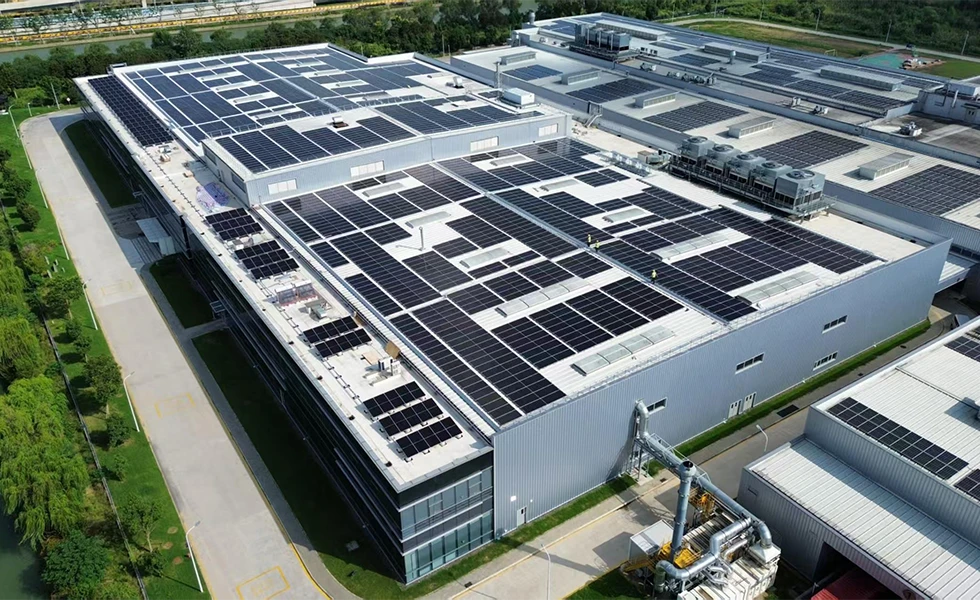
Our continued rollout of on-site solar panels at our facilities in Saudi Arabia, China, India, Mexico and Austria are estimated to transition a combined 5.15MWp (Megawatt peak) capacity addition to on-site renewable energy.
2 We source 100% renewable electricity for our production and compensate for all remaining non‑renewable energy through Gold Standard CO2 offsets.

Decarbonizing our value chain
Scope 3
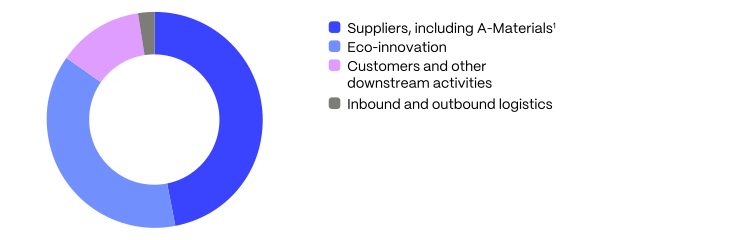
The efforts needed to decarbonize our value chain will need to be varied and impactful. In developing the pathway to our 2030 and 2050 targeted Scope 3 greenhouse gas reductions per liter packed of 51.6% and 97% respectively (from 2020), we have identified key areas that will continue to drive us forward on our efforts thus far and additionally support our Nature+ commitments.
Targeted 2030 greenhouse gas Scope 3 reductions
Suppliers, including A-materials3
VP Global Sourcing & Procurement
Reducing emissions from our suppliers is critical, as they represent a significant share of our supply chain footprint. By collaborating on low-carbon materials and processes, we can drive deep reductions at the source.
Targeted 2030 greenhouse gas Scope 3 reductions – suppliers

Reduce 35% of CO2 emissions from our A-material3 suppliers, by 2030 (from 2020)
We seek optimal impact on supplier collaborations by scoping and priority setting to identify key suppliers with the capacity to strengthen emissions measurement and reduction and enhance energy and resource efficiency.
Targeted collaboration is provided to suppliers through capacity building, tailored resources, and expert guidance to help them adopt sustainability practices aligned with climate science.
Our collaboration with suppliers to implement low-carbon technologies includes three areas:
energy efficiency upgrades such as process optimization and high efficiency equipment;
renewable electricity adoption through PPAs or on-site generation; and
sustainable production methods such as low-carbon materials, closed-loop systems, and ISO-aligned management practices.
Suppliers are encouraged to optimize sourcing practices by improving material efficiency, minimizing waste and selecting more sustainable alternatives if available.
With our aluminum suppliers, we encourage them to use green ingots in their production, or by partnering with suppliers who operate green smelters powered by renewable energy.
We shift to low-carbon and recycled materials by sourcing sustainable alternatives produced with renewable energy and incorporating recycled content into packaging.
Our Climate+ tendering process is being deployed to further embed sustainability into procurement decisions.
Where possible, we include binding clauses on GHG emission reduction into supplier contracts.
Suppliers with Science-Based Reduction Targets
We prioritize suppliers that have aligned their greenhouse gas reduction targets with the Science Based Target Initiative (SBTi) or other established scientific methods. 36% of our A-material3 suppliers have SBTs, and a further 25% have commitments aligned with a 1.5°C decarbonization pathway.
3 See Responsible culture: Our suppliers for our A-materials definition.
Product innovation
VP Global Research & Development and VP Global Product Marketing
Innovating our product portfolio not only advances our targets to lower emissions even further but also supports a more resource-efficient future. By rethinking how our packaging is sourced, designed, and recovered, we can drive a significant reduction in our value chain emissions.
Targeted 2030 greenhouse gas Scope 3 reductions – product innovation

Reduce 15% of Scope 3 greenhouse gas emission through SIG Product Innovation, by 2030 (from 2020)
Our product innovation efforts are closely aligned with the ambitions outlined in our Resource+ commitments which focus on maximizing renewable content, reducing raw material use and designing packaging for effective recycling.
Optimizing material use not only conserves resources but also minimizes emissions associated with extraction, processing, and transport. Furthermore, designing packaging for effective recycling helps close the loop, reducing the need for virgin materials and the emissions tied to their production.
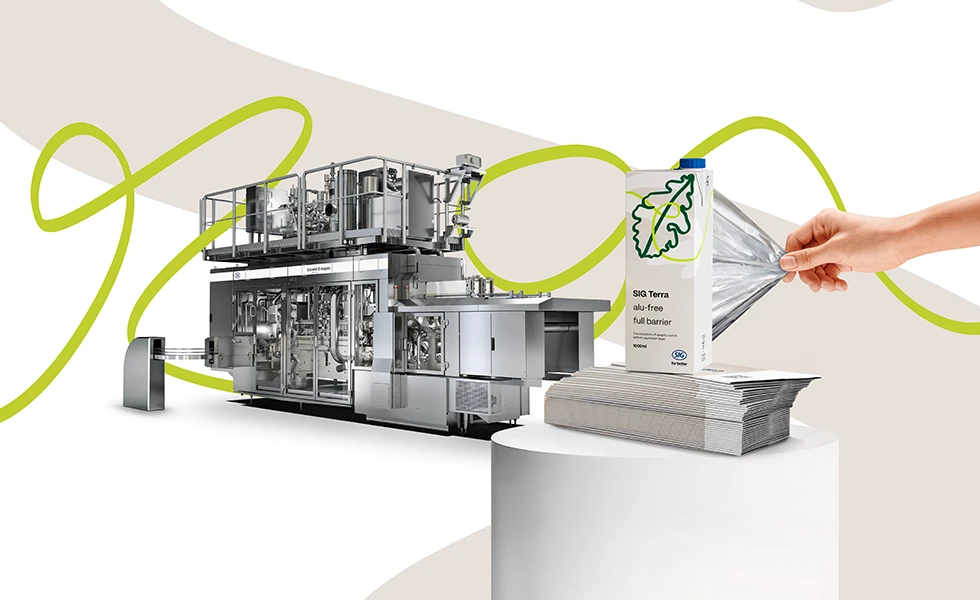
One of the significant drivers in both decarbonization and resource minimization is the continued rollout of our SIG Terra Alu-free + Full barrier aseptic carton as part of our SIG Terra solutions.
SIG Terra portfolio
Our SIG Terra portfolio solutions lower the carbon footprint of our aseptic cartons even further, compared with standard SIG aseptic cartons, including by up to 61%1 for our SIG Terra Alu-free + Full barrier + Forest-based polymers2 solution.
By accelerating the global rollout of our SIG Terra portfolio, we estimate a cumulative reduction potential of ~139.7 ktCO2e by 20303 in our Scope 3 upstream emissions (materials and packaging components). In parallel, our customers can achieve an additional reduction of approximately 25% in cradle-to-SIG-gate emissions4, supporting their own science-based targets and decarbonization roadmaps.
1 Life-cycle assessment for CB-100740 in Europe.
2 Via an independently certified mass balance system.
3 Based on our 2024 LEAP Forecast.
4 Illustrative figures referring to the climate change impact of an average 1 liter SIG aseptic beverage carton in Europe based on indicative results from our internal life-cycle assessment tool.
Customers and other downstream activities
VP Global Research & Development supported by VP Global Product Marketing
Partnering with customers to reduce downstream emissions helps extend our impact beyond our operations. By enabling more sustainable use and end-of-life solutions, we support a low-carbon value chain.
Targeted 2030 greenhouse gas Scope 3 reductions – other downstream activities

Reduce 35% of CO2 emissions from other downstream activities by 2030 (from 2020)
We are transitioning our aseptic carton portfolio to innovative, low-carbon, aluminum-layer-free packaging solutions (see Our sustainable packaging journey), helping customers significantly reduce Scope 3 emissions.
Every new machine is designed to use resources more efficiently, helping reduce the amount of energy, compressed air, hydrogen peroxide and water needed to run equipment at our customers’ factories.
Through our SIG EcoFill Consulting program, we support aseptic carton customers in identifying opportunities to reduce resource use in their filling lines.
We provide tools and resources to help all our customers measure the carbon footprint of our products, supporting their transition to more sustainable operations.
Assistance is offered for energy efficiency projects, including process optimization, advanced monitoring and high-efficiency equipment to help customers cut emissions.
Strengthening circularity through our Resource+: Recycling at scale commitment contributes significantly to Scope 3 reductions in end-of-life treatment by diverting used packaging from landfill into recycling.
SIG EcoFill Consulting program
The SIG EcoFill Consulting program continues to deliver value chain GHG, energy and water reduction for our customers and supports our ambition to decarbonize our value chain.
Key to the program are semi-automated cleaning machines, which cut water use by 54% compared with manual cleaning, and water reduction kits, designed to cut water consumption by up to 50%.
In 2025, the installation of 53 upgrade kits through the SIG EcoFill Consulting program helped our customers to reduce resource use, enabling annual savings of around 36 million liters of water, 1.09 million m3 of compressed air, 207 MWh of energy, and approximately 75 metric tons of CO2 emissions.
Inbound and outbound logistics
VP Global Sourcing & Procurement
Optimizing logistics is essential to cut transport-related emissions across our supply chain. Shifting to lower-emission modes and improving efficiency will reduce our footprint while enhancing resilience.
Targeted 2030 greenhouse gas Scope 3 reductions – inbound and outbound logistics

Reduce 25% of CO2 emissions from inbound and outbound logistics4, by 2030 (from 2020)
Inbound logistics have been optimized to cut transport emissions by streamlining supply chain design, reducing empty miles, and partnering with certified low-carbon logistics providers.
We have begun fleet electrification in collaboration with suppliers and logistics partners by deploying electric trucks, installing charging infrastructure, and implementing energy management systems.
Intermodal transportation is being expanded through modal shifts to rail, inland waterways, and other lower-carbon alternatives.
We have deployed route optimization and load consolidation technologies to improve transport efficiency and maintain a high truck utilization rate, thereby minimizing emissions.
Truck utilization rates are monitored monthly to identify and enhance our efficiency in outbound logistics.
Sustainable fuel options, including mass balancing for road fleets and maritime transport, are being assessed and piloted as complementary pathways where electrification is not yet feasible.
Optimizing logistics efficiency through pallet scheme conversion
In 2025, SIG continued its shift from one-way pallets to pooled solutions, which includes pallet conversion through the recovery, repair, and redistribution of pallets in a supply chain. Reflecting our commitment to sustainable logistics and circular supply chain practices, our aseptic business in Europe achieved a conversion rate of about 77% to the CHEP company pooled pallet scheme (approximately 74% in 2024).
4 Reduction of greenhouse gas Scope 3 categories 4 and 9.
Reducing climate impacts beyond our value chain5
Director Group Corporate Responsibility
To achieve climate-positive outcomes, we extend our efforts beyond our own value chain by supporting broader system transformation. This includes initiatives that strengthen ecosystem resilience, accelerate sector-wide decarbonization and empower informed decision-making – helping to reduce emissions across the wider food and beverage value chain.
Together with our customer Nestlé, we partner with public institutions to support cross-sector decarbonization, such as co-funding the Chair in Sustainable Materials at the Institute of Materials School of Engineering at EPFL (École Polytechnique Fédérale de Lausanne), which researches renewable and underutilized bio-based resources as substitutes for fossil polymer feedstocks. In 2025, this collaboration yielded four scientific publications on nanocellulose films, mycelium composites, lignin-based materials, and aerogels from waste streams.
Evidence of our lowest carbon footprint solutions are provided through publicly available, critically reviewed life-cycle assessment studies aligned with ISO 14040 standards, enabling informed and factual decision-making (see Our sustainable packaging journey)
Through our Resource+ commitments, we enhance sector-wide end-of-life collection and recycling by embedding design-for-recycling principles and expanding recycling capacity at scale through global collaborations.
We support nature-based solutions by investing in land restoration and improved landscape management programs that strengthen ecosystem resilience (see Nature+: Support thriving forests).
Partnerships with NGOs, governments, and industry groups help us drive innovation in sustainability and promote climate-positive initiatives beyond our immediate footprint, such as the Food Cluster in the Climate-Health Coalition hosted by Forum for the Future (see Food+: Help transform the food system)
Empowering informed choices
In 2025, we advanced our commitment to transparency by completing independent life-cycle assessments (LCAs) for our Bag-in-Box and Spouted Pouch6 solutions in the United States, aligned with ISO 14040 and 14044 standards, and confirmed consistency with our 2024 European LCAs. The results are publicly available, enabling consumers, retailers, and brand owners to make informed, climate impact product choices based on verified data.
The findings were compelling:
Bag-in-Box for wine showed up to an 83% reduction in CO2-eq. emissions compared to lightweight glass bottles, and up to 87% compared to standard glass.
Spouted Pouches for fruit-based purées delivered up to 57% less than plastic tubs and up to 83% lower CO2-eq. emissions than glass jars.
By making this data accessible, we empower consumers to choose packaging that aligns with their sustainability values, helping reduce climate impacts far beyond our own value chain.
5 Reducing climate impacts beyond our value chain refers to climate benefits and impact reductions that other actors can achieve related to our products, services and action. Agreed methods to capture and account for positive outcomes are in development.
6 Based on life-cycle assessments using the ISO 14040 and ISO 14044 international standards and critically reviewed by an independent expert panel of an average SIG Bag-in-Box CB-100736 and a SIG Terra Spouted Pouch CB-100738 for the United States and Europe.
Assessing effectiveness
In addition to the performance assessment of our targets and Key performance indicators, we assess the effectiveness of our Climate+ policies and actions through our Climate Positive program reporting listed below. The program has been established to develop emission reduction milestones, closely monitor progress and make adjustments as needed to ensure we meet our mid- and long-term goals, as well as customer expectations.
Reducing climate impacts beyond our value chain is assessed in line with actions on Resource+, Nature+ and Food+.
Reporting |
|
Department |
|
Responsible |
|
Regularity |
|---|---|---|---|---|---|---|
Decarbonizing our value chain (including operations in the Climate Positive program) |
||||||
Energy consumption |
|
Manufacturing plants |
|
Chief Supply Chain Officer |
|
Monthly |
Direct emissions |
|
|
|
|||
Raw materials for packaging |
|
Global Sourcing and Procurement |
|
Chief Supply Chain Officer |
|
Quarterly |
Energy sourcing |
|
|
|
|||
Raw materials for equipment |
|
Equipment Sourcing and Procurement |
|
|
||
Upstream transportation |
|
Global Supply Chain Management |
|
|
||
Downstream transportation |
|
|
|
|||
Processing and use of sold products |
|
Product Management Equipment |
|
|
||
Treatment of sold products |
|
Group Corporate Responsibility |
|
|
||
Sustainable product portfolio development and deployment |
|
Global Product Marketing |
|
Chief Marketing Officer |
|
Quarterly |
Our targets and performance
2020 to 2025 targets and performance
Target |
|
Material topics |
|
Progress tracker |
|
2025 performance |
|
Next steps |
||||||
|---|---|---|---|---|---|---|---|---|---|---|---|---|---|---|
Net zero value chain greenhouse gas emissions by 2050 |
|
|
|
|
|
We redesigned our decarbonization strategy to strengthen progress through 2030, ensure alignment with our Science-Based Targets, and set a clearer long-term pathway toward 2050 that extends beyond our operations and value chain. While this redesign improves strategic clarity and direction, additional work is still needed to accelerate implementation and progress toward Net Zero. |
|
Retained in our Climate+ and Science Based Target Initiative (SBTi) commitments. |
||||||
Reduce Scope 1 and 2 greenhouse gas emissions by 42% by 2030, and by 90% by 2050 (from 2020) |
|
|
|
|
Scope 1 and 2 absolute reductions have remained stable (78% in 2025), supported by continued execution of our operational decarbonization plan to sustain progress against our 2030 pathway and maintain momentum toward our longer-term targets. |
|
Retained in our Decarbonizing our operations and SBTi commitments. |
|||||||
Maintain 100% renewable electricity and Gold Standard CO2 offset for all non-renewable energy (at production plants) |
|
|
|
|
We continue to source 100% renewable electricity for our production and compensate for all remaining non-renewable energy through Gold Standard CO2 offsets. |
|
We have retained our renewable electricity target, while non-renewable energy is covered under our Scope 1 reduction target in our Decarbonizing our operations commitment. |
|||||||
Expand use of on-site solar power to meet at least 10% of our global electricity use as part of overall renewable power purchase agreements (PPAs) to meet 25% of our global electricity use by 2025 |
|
|
|
|
We have expanded our total on-site solar capacity to 38.9 MWp. On-site solar power met 7.3% of our global electricity needs for production this year and, overall, renewable PPAs (both on- and off-site) met 24.7%. |
|
Retained in our Decarbonizing our operations commitment. |
|||||||
Transition to 100% bioethanol or other biomaterials for printing our aseptic cartons by 2025 |
|
|
|
|
|
Since January 2024 all of our aseptic plants only purchase plant-based ethanol for printing purposes. |
|
With the target now completed, we are focusing on more strategically impactful initiatives. |
||||||
Reduce Scope 3 greenhouse gas emissions by 51.6% per liter packed by 2030, and by 97% by 2050 (from 2020) |
|
|
|
|
|
Our Scope 3 emissions per liter packed decreased by 9% from 2020, slightly behind our reduction pathway. |
|
Retained in our Decarbonizing our value chain and SBTi commitments |
||||||
Reduce CO2 emissions from inbound and out bound logistics1 by 18% (from 2020) by 2025 |
|
|
|
|
Inbound and outbound logistics emissions have remained at 2020 levels, putting us slightly behind target; however, we strengthened the enablers needed to accelerate reductions going forward. |
|
Updated in our Decarbonizing our value chain commitment. |
|||||||
Reduce energy use by 20%, hydrogen peroxide use by 35%, and water use by 25% per hour of runtime in our next-generation filling machine for mid-size format aseptic carton packs2 by 2025 |
|
|
|
|
|
Progress was made towards intended efficiency targets with the launch of SIG Neo Slim 15 in 2025. |
|
We will continue to reduce consumable use in our machines in line with our Decarbonizing our value chain commitment. |
||||||
Reduce use of consumables by 25% for the next-generation filling machine for small format aseptic carton packs by 2025 |
|
|
|
|
|
We are continuing to work on a single serve filling machine that will reduce the use of consumables. |
|
We will continue to reduce consumable use in our machines in line with our Decarbonizing our value chain commitment. |
||||||
|
||||||||||||||


See Appendix: Key performance indicators for related key performance indicators.
2026 to 2030 targets
Target |
|
Material topics |
|
2025 performance |
||||||||
|---|---|---|---|---|---|---|---|---|---|---|---|---|
Net zero value chain greenhouse gas emissions by 2050 |
|
|
|
We redesigned our decarbonization strategy to strengthen progress through 2030, ensure alignment with our Science-Based Targets, and set a clearer long-term pathway toward 2050 that extends beyond our operations and value chain. While this redesign improves strategic clarity and direction, additional work is still needed to accelerate implementation and progress toward Net Zero. |
||||||||
Decarbonizing our Operations |
||||||||||||
Reduce absolute Scope 1 and 2 greenhouse gas emissions by 42% by 2030, and by 90% by 2050 (from 2020) |
|
|
|
Scope 1 and 2 absolute reductions have remained stable (78% in 2025), supported by continued execution of our operational decarbonization plan to sustain progress against our 2030 pathway and maintain momentum toward our longer-term targets. |
||||||||
Reduce 42% of our absolute Scope 1 emissions, by 2030 (from 2020) |
|
|
Our Scope 1 emissions reduction remains on track, with an absolute reduction of 29% to date. |
|||||||||
Maintain 100% renewable electricity (at production plants)1 |
|
|
We sourced 100% renewable electricity for our production in 2025. |
|||||||||
Maintain at least 25% of our global electricity consumption for our production covered by PPAs, thereof at least 10% should come from on-site solar generation |
|
|
We have expanded our total on-site solar capacity to 38.9 MWp. On-site solar power met 7.3% of our global electricity needs for production this year and, overall, renewable PPAs (both on- and off-site) met 24.7%. |
|||||||||
Decarbonizing our Value Chain |
||||||||||||
Reduce Scope 3 greenhouse gas emissions by 51.6% per liter packed by 2030, and by 97% by 2050 (from 2020) |
|
|
|
Our Scope 3 emissions per liter packed decreased by 9% from 2020, slightly behind our reduction pathway. |
||||||||
Reduce 35% of CO2 emissions from our A-material2 suppliers, by 2030 (from 2020) |
|
|
Reporting from 2026 |
|||||||||
Reduce 15% of Scope 3 greenhouse gas emission through SIG Product Innovation, by 2030 (from 2020) |
|
|
Reporting from 2026 |
|||||||||
Reduce 35% of CO2 emissions from other downstream activities, by 2030 (from 2020) |
|
|
Reporting from 2026 |
|||||||||
Reduce 25% of CO2 emissions from inbound and outbound logistics3, by 2030 (from 2020) |
|
|
Inbound and outbound logistics emissions have remained at 2020 levels, putting us slightly behind target; however, we strengthened the enablers needed to accelerate reductions going forward. |
|||||||||
|
||||||||||||
See Appendix: Key performance indicators for related key performance indicators.
Outlook
Our path towards net zero
From Baseline to Transformation
Our 2020 baseline serves as the foundation for our long-term reduction pathway. Between 2020 and 2030, business growth is expected to increase emissions due to higher production volumes and expanding markets. This growth effect sets a realistic benchmark for the scale of decarbonization required to achieve our SBTi-aligned target.
Decarbonization Levers and 2030 Target
By 2025, we have already identified over 40 projects across five primary decarbonization levers with quantified reduction potential and defined financial implications. Each project was assessed for emission impact, implementation feasibility, and financial performance, ensuring that our roadmap is both scientifically robust and economically sound.
Decarbonizing our operations and value chain on our path to net zero
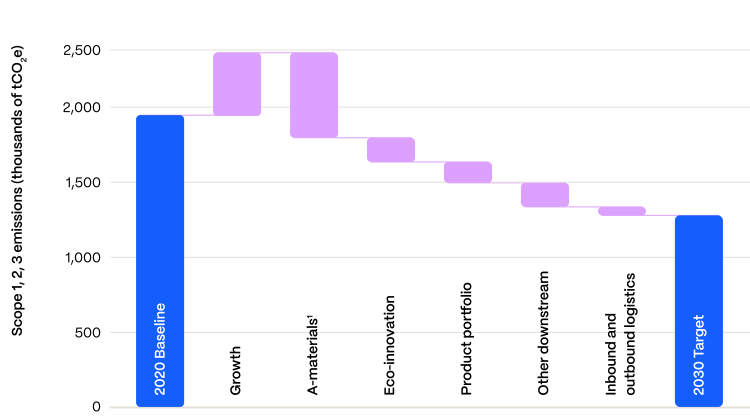
To meet our 2030 ambition, we will continue to operate, pilot, or deploy these projects over the next 5 years. Each lever corresponds to one of the reduction steps in our roadmap and collectively drives our transition toward science-based targets.
The cumulative effect of these actions leads to our 2030 target aligned with climate science, representing a substantial reduction in absolute emissions despite business growth. This pathway demonstrates that decarbonization and business expansion can coexist when driven by innovation, collaboration, and disciplined execution.
Decarbonizing our operations
Decarbonizing our operations will continue in earnest by phasing out fossil fuel by modernizing equipment to lower gas consumption, substituting materials that require thermal energy, and transitioning key production processes toward electricity-based solutions, and research of on-site carbon capture. Across our sites, we will continue to improve energy efficiency and source renewable electricity, while exploring battery storage to maximize solar energy use, as well as electrifying our fleet.
Suppliers, including A-materials3
As a key enabler of our reduction target, we are launching the SIG Climate+ Accelerator program to strengthen collaboration with our suppliers and accelerate measurable decarbonization across our value chain. Through this program, we will support suppliers in building the necessary capabilities, developing science-based reduction pathways, and implementing practical solutions that enable a shift from commitment to tangible progress. The program is underpinned by our extensive experience in deploying 100% renewable electricity and energy-efficiency projects, and it will be further supported by the Institut für Energie- und Umweltforschung Heidelberg gGmbH (ifeu) to bring expert know-how for the development of climate-ready execution plans. These efforts are complemented by Climate+ tendering, tailored guidance, and binding GHG reduction clauses to ensure accountability and alignment with our long-term net zero ambition.
We are also advancing procurement strategies that integrate emissions forecasts aligned with our sales goals and sourcing plans, ensuring future growth remains consistent with our decarbonization pathway. This includes a targeted shift toward sustainable, low-carbon, and recycled materials, developed in close partnership with our suppliers. Together, we are driving the development of commercially ready, lower-carbon packaging solutions that support the broader transition toward circular, climate-aligned and regenerative value chains.
3 See Responsible culture: Our suppliers for our A-materials definition.
Product portfolio
Our product innovation journey is entering a pivotal phase, with the scale-up of our alu-layer-free aseptic carton as a central driver of decarbonization and circularity. By phasing out the aluminum layer with our SIG Terra Alu-free + Full barrier portfolio, we will not only be reducing Scope 3 emissions but also unlock access to more efficient recycling systems – further complemented by our push to increase paper content (see Resource+). These innovations significantly lower the carbon footprint of our aseptic cartons and support our customers in meeting their own climate goals.
Eco-innovation
Alongside material innovation, we continue optimizing filling line operations to reduce energy consumption at customer sites and advancing the recyclability and reduced carbon impact of our spouted pouches and bag-in-box.
Customers and other downstream activities
Building on the continued enhancement of our packaging recyclability, we are broadening our recycling initiatives to further mitigate emissions associated with product end-of-life. This includes reinforcing industry collaborations, investing in advanced recycling technologies, and expanding programs that strengthen collection systems and improve recycling rates across key markets.
In parallel, through our Climate+ Accelerator, we are expanding our customer service offerings to actively support their energy transition. This involves assisting customers in the identification, integration, and deployment of commercially viable energy-efficiency measures and renewable electricity projects. Together, these initiatives create shared value by reducing emissions throughout the entire packaging life cycle and enabling our customers to advance toward their decarbonization and net zero objectives.
Inbound and outbound logistics
As part of the Climate+ Accelerator, we are also introducing Climate+ tendering for transport suppliers and collaborating with strategic partners to evaluate alternative fuel options that can accelerate the transition to low-carbon logistics. We are also enhancing the efficiency of our inbound and outbound transport through fleet electrification, intermodal solutions, load optimization projects, and improved route planning. These initiatives aim to reduce transport-related emissions while promoting circular supply chain practices, such as pooled pallet systems and shared logistics infrastructure, to maximize resource efficiency across our network.