Report of the statutory auditor
to the General Meeting of SIG Group AG, Neuhausen am Rheinfall

Report on the audit of the consolidated financial statements
Opinion
We have audited the consolidated financial statements of SIG Group AG and its subsidiaries (the Group), which comprise the consolidated statement of profit or loss and other comprehensive income for the year ended December 31, 2025, the consolidated statement of financial position as at December 31, 2025, the consolidated statement of changes in equity and the consolidated statement of cash flows for the year then ended, and notes to the consolidated financial statements, including material accounting policy information.
In our opinion, the consolidated financial statements (pages 223 to 289) give a true and fair view of the consolidated financial position of the Group as at December 31, 2025, and of its consolidated financial performance and its consolidated cash flows for the year then ended in accordance with IFRS Accounting Standards and comply with Swiss law.
Basis for opinion
We conducted our audit in accordance with Swiss law, International Standards on Auditing (ISA) and Swiss Standards on Auditing (SA-CH). Our responsibilities under those provisions and standards are further described in the ‘Auditor’s responsibilities for the audit of the consolidated financial statements’ section of our report. We are independent of the Group in accordance with the provisions of Swiss law and the requirements of the Swiss audit profession that are relevant to audits of the financial statements of public interest entities, as well as the International Code of Ethics for Professional Accountants (including International Independence Standards) issued by the International Ethics Standards Board for Accountants (IESBA Code), as applicable to audits of financial statements of public interest entities. We have also fulfilled our other ethical responsibilities in accordance with these requirements.
We believe that the audit evidence we have obtained is sufficient and appropriate to provide a basis for our opinion.
Our audit approach
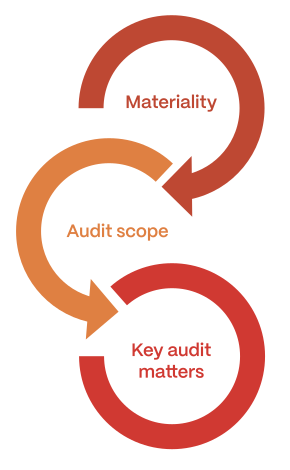
Overview
Overall group materiality: €32 million
The entities addressed by our full scope audit work as well as specified procedures contribute to 83% of the Group’s revenues
As key audit matters the following areas of focus have been identified:
Recoverability of goodwill
Impairment of intangible and other long-lived assets
Materiality
The scope of our audit was influenced by our application of materiality. Our audit opinion aims to provide reasonable assurance that the consolidated financial statements are free from material misstatement. Misstatements may arise due to fraud or error. They are considered material if, individually or in aggregate, they could reasonably be expected to influence the economic decisions of users taken on the basis of the consolidated financial statements.
Based on our professional judgement, we determined certain quantitative thresholds for materiality, including the overall Group materiality for the consolidated financial statements as a whole as set out in the table below. These, together with qualitative considerations, helped us to determine the scope of our audit and the nature, timing and extent of our audit procedures and to evaluate the effect of misstatements, both individually and in aggregate, on the consolidated financial statements as a whole.
Overall Group materiality |
|
€32 million |
|---|---|---|
Benchmark applied |
|
Revenue |
Rationale for the materiality benchmark applied |
|
We chose revenue as the benchmark as, in our view, it is the most appropriate measure considering the Group’s current year’s result is impacted by effects from purchase price accounting. It is further a generally accepted benchmark. |
We agreed with the Audit and Risk Committee that we would report to them misstatements above €3 million identified during our audit as well as any misstatements below that amount which, in our view, warranted reporting for qualitative reasons.
Audit scope
We designed our audit by determining materiality and assessing the risks of material misstatement in the consolidated financial statements. In particular, we considered where subjective judgements were made; for example, in respect of significant accounting estimates that involved making assumptions and considering future events that are inherently uncertain. As in all of our audits, we also addressed the risk of management override of internal controls, including among other matters consideration of whether there was evidence of bias that represented a risk of material misstatement due to fraud.
We tailored the scope of our audit in order to perform sufficient work to enable us to provide an opinion on the consolidated financial statements as a whole, taking into account the structure of the Group, the accounting processes and controls, and the industry in which the Group operates.
Key audit matters
Key audit matters are those matters that, in our professional judgement, were of most significance in our audit of the consolidated financial statements of the current period. These matters were addressed in the context of our audit of the consolidated financial statements as a whole, and in forming our opinion thereon, and we do not provide a separate opinion on these matters.
Recoverability of goodwill
Key audit matter |
|
How our audit addressed the key audit matter |
|---|---|---|
As at December 31, 2025, the carrying amount of goodwill was €3,034.8 million, allocated to different groups of cash generating units (CGUs), which for impairment testing purpose are the four operating (and reportable) segments. |
|
We assessed whether the CGUs identified by Management are appropriate. |
|
|
|
|
We further performed independent sensitivity analyses around the key assumptions to ascertain the extent of changes in those assumptions that either individually or collectively would be required for the goodwill to be impaired and verified proper disclosure of these sensitivities in the notes. |
Impairment of intangible and other long-lived assets
Key audit matter |
|
How our audit addressed the key audit matter |
|---|---|---|
As announced on September 18, 2025, following a strategic review of the business and in light of the prevailing soft market conditions, the Group has recognized impairment losses and other charges of €350.7 million pre-tax. |
|
We assessed whether the businesses identified by Management are the appropriate basis for impairment testing. |
|
|
|
|
We also involved our internal valuation experts to evaluate Management’s fair value less costs of disposal calculation for individual assets. |
Other information
The Board of Directors is responsible for the other information. The other information comprises the information included in the annual report, but does not include the financial statements, the consolidated financial statements, the compensation report and our auditor’s reports thereon.
Our opinion on the consolidated financial statements does not cover the other information and we do not express any form of assurance conclusion thereon.
In connection with our audit of the consolidated financial statements, our responsibility is to read the other information and, in doing so, consider whether the other information is materially inconsistent with the consolidated financial statements or our knowledge obtained in the audit or otherwise appears to be materially misstated.
If, based on the work we have performed, we conclude that there is a material misstatement of this other information, we are required to report that fact. We have nothing to report in this regard.
Board of Directors’ responsibilities for the consolidated financial statements
The Board of Directors is responsible for the preparation of consolidated financial statements, that give a true and fair view in accordance with IFRS Accounting Standards and the provisions of Swiss law, and for such internal control as the Board of Directors determines is necessary to enable the preparation of consolidated financial statements that are free from material misstatement, whether due to fraud or error.
In preparing the consolidated financial statements, the Board of Directors is responsible for assessing the Group’s ability to continue as a going concern, disclosing, as applicable, matters related to going concern and using the going concern basis of accounting unless the Board of Directors either intends to liquidate the Group or to cease operations, or has no realistic alternative but to do so.
Auditor’s responsibilities for the audit of the consolidated financial statements
Our objectives are to obtain reasonable assurance about whether the consolidated financial statements as a whole are free from material misstatement, whether due to fraud or error, and to issue an auditor’s report that includes our opinion. Reasonable assurance is a high level of assurance, but is not a guarantee that an audit conducted in accordance with Swiss law, ISA and SA-CH will always detect a material misstatement when it exists. Misstatements can arise from fraud or error and are considered material if, individually or in the aggregate, they could reasonably be expected to influence the economic decisions of users taken on the basis of these consolidated financial statements.
A further description of our responsibilities for the audit of the consolidated financial statements is located on EXPERTsuisse’s website: http://www.expertsuisse.ch/en/audit-report. This description forms an integral part of our report.
Report on other legal and regulatory requirements
In accordance with article 728a para. 1 item 3 CO and PS-CH 890, we confirm the existence of an internal control system that has been designed, pursuant to the instructions of the Board of Directors, for the preparation of the consolidated financial statements.
We recommend that the consolidated financial statements submitted to you be approved.
PricewaterhouseCoopers AG
Joanne Burgener
Licensed audit expert
Auditor in charge
Tobias Handschin
Licensed audit expert
Basel, February 27, 2026
PricewaterhouseCoopers AG, St. Jakobs-Strasse 25, 4002 Basel, Telefon: +41 58 792 51 00, www.pwc.ch
PricewaterhouseCoopers AG is a member of the global PricewaterhouseCoopers network of firms, each of which is a separate and independent legal entity.