Financial review
Stable revenue in a challenging market environment; clear roadmap to drive future value creation.
In 2025, the market environment continued to be subdued as a result of weak consumer sentiment. Despite these conditions, the Group achieved a revenue increase of 0.4% on a constant currency basis and 0.1% on both a constant currency and constant resin basis. The adjusted EBITDA margin for the year was 22.1% (24.2% excluding non-recurring charges).

In 2025, SIG operated in a challenging economic environment, particularly on the consumer side, resulting in more volatile demand. In response, we took decisive action to sharpen our strategic focus. Following an in-depth strategy review, we defined a clear roadmap to improve business performance, focusing on portfolio optimization, operational improvement and a more rigorous approach to capital discipline. We are confident that these priorities, combined with SIG’s unique business model and strong innovation capabilities, provide a solid foundation for long-term value creation.
For 2026, we anticipate market conditions to remain broadly similar to 2025. We expect total revenue growth at constant currency and constant resin for 2026 to be in the range of 0-2% with an adjusted EBIT margin between 15.7% and 16.2%. In line with our usual seasonality, we expect revenue and adjusted EBIT margins to be stronger in the second half of the year. Our guidance remains subject to input cost developments and foreign exchange volatility.
Anne Erkens
CFO
Key events in 2025 impacting the performance of the Group
Refinancing transactions
The Group issued €625 million of senior unsecured bonds in March 2025. Proceeds from the issue of bonds, together with draw-downs of the Group’s revolving credit facilities, were used to repay €550 million of senior unsecured notes and €85.5 million of unsecured Schuldscheindarlehen (“SSD”, a private German debt placement) that were due in June 2025. See note 23 of the consolidated financial statements for the year ended December 31, 2025 for additional details.
Impact of strategic review and soft market conditions
In 2025, SIG’s performance has been impacted by weak consumer sentiment, with prices remaining at an elevated level, the Euro strengthening across most major currencies and overall market turbulence with heightened uncertainty on tariffs and fiscal policies.
In light of these prevailing soft market conditions and latest market outlook, the Board of Directors initiated a review of the Group’s strategic direction. As per the outcome of the strategic review, SIG will focus on its higher-margin, higher-growth aseptic businesses. In line with this, SIG will initiate a divestment of smaller non-aseptic businesses and address various non-core parts of the portfolio. SIG will also undertake various performance improvement activities and implement a more rigorous approach to capital investments.
Considering the soft market conditions, the updated growth forecasts and the refined strategy, a number of individual assets and cash generating units were tested for impairment in the third quarter of 2025.
The total pre-tax impact of impairment losses and other charges resulting from various assessments and actions undertaken by management is €350.7 million (€295.3 million post-tax) for the year ended December 31, 2025. The majority of these charges are non-cash. Cash outflows of around €25 million are expected in 2026.
The table below provides an overview of the charges recognized for the year ended December 31, 2025 following the strategic review and soft market conditions.
|
|
Year ended December 31, 2025 |
||||||||||
|---|---|---|---|---|---|---|---|---|---|---|---|---|
(In € million, pre-tax) |
|
Bag-in-box and spouted pouch |
|
Chilled carton |
|
Markets and capacity |
|
Innovation |
|
Restructuring and other |
|
Total impairment losses and other charges |
Customer relationships |
|
63.0 |
|
43.6 |
|
– |
|
– |
|
– |
|
106.6 |
Technology assets |
|
16.2 |
|
6.8 |
|
– |
|
– |
|
– |
|
23.0 |
Trademarks |
|
5.8 |
|
– |
|
– |
|
– |
|
– |
|
5.8 |
Capitalized development costs |
|
– |
|
– |
|
– |
|
13.5 |
|
– |
|
13.5 |
Right-of-use assets |
|
– |
|
11.5 |
|
24.4 |
|
3.2 |
|
– |
|
39.1 |
Production equipment |
|
20.3 |
|
23.8 |
|
29.5 |
|
0.3 |
|
– |
|
73.9 |
Filling lines |
|
– |
|
– |
|
21.2 |
|
28.4 |
|
– |
|
49.6 |
Total impairment losses |
|
105.3 |
|
85.7 |
|
75.1 |
|
45.4 |
|
0.0 |
|
311.5 |
Restructuring costs |
|
– |
|
– |
|
– |
|
– |
|
8.6 |
|
8.6 |
Other charges |
|
2.0 |
|
– |
|
7.2 |
|
16.4 |
|
5.0 |
|
30.6 |
Total other charges |
|
2.0 |
|
0.0 |
|
7.2 |
|
16.4 |
|
13.6 |
|
39.2 |
Total charges |
|
107.3 |
|
85.7 |
|
82.3 |
|
61.8 |
|
13.6 |
|
350.7 |
Of the total charges recognized as part of “Markets and capacity”, impairment losses of €37.6 million and other charges of €5.6 million relate to the Indian aseptic carton business.
The other charges of €30.6 million include penalties for pausing further expansion of the aseptic carton production plant in India, costs associated with recent innovations (including the Ultima project and new product releases), termination benefits relating to the former Chief Executive Officer and consulting costs relating to 2025 strategic review topics.
Bag-in-box and spouted pouch
The bag-in-box and spouted pouch businesses have experienced a slowdown in their end markets. Subdued consumer demand, driven by persistently high prices in the end markets we serve, has lowered the growth expectations compared to previous forecasts.
Chilled carton
The chilled carton market is currently experiencing a decline driven by the down-turn of the economy, subdued consumer demand and increased competition. Considering these factors, the Board of Directors decided in its review of the Group’s strategy to find a strategic partner for this business.
Markets and capacity
In the context of the current weaker market environment and the recently updated strategic direction of the Group, management has re-assessed the required operating needs of the Group (for both the aseptic carton business in India and its aseptic carton production plants outside India) as well as of the current and future customer use and demand of filling lines presented as property plant and equipment on the statement of financial position.
Regarding the aseptic carton business in India, it is currently experiencing lower consumer demand and strong competition. Considering the low price points and the projected outlook for the region, management has decided to pause further expansion until the Indian aseptic carton business can meet sizable economies of scale.
Innovation
The Board of Directors decided in September 2025 to cease further marketing of and investments in the Ultima filling machine and related assets. The non-recurring charges relate to costs associated with recent innovations, including the Ultima project and new product releases.
Restructuring and other
The Group has initiated a performance improvement program, which includes footprint rationalization and the alignment of headcounts to the Group’s reassessed needs. Expenses for termination benefits relating to the former Chief Executive Officer and consulting costs relating to 2025 strategic review topics were also incurred.
See note 4 of the consolidated financial statements for the year ended December 31, 2025 for additional details.
Sale of production plant completed
The Group moved its production of chilled carton from Shanghai to Suzhou in 2024. The sale of the production plant in Shanghai was completed in October 2025. The assets were sold for €16.2 million, with a resulting pre-tax gain of €2.0 million.
Financial performance
Revenue
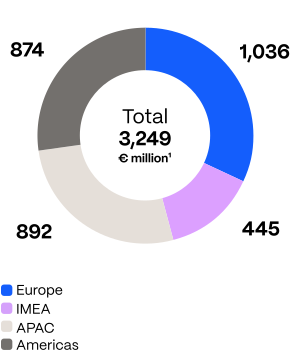
Revenue in 2025 increased by 0.4% on a constant currency basis (decline 2.4% reported and 0.1% at constant currency and constant resin) to €3,248.7 million (2024: €3,328.5 million).
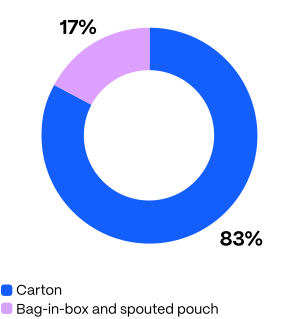
Aseptic carton revenue increased by 1.2% at constant currency, driven by annual price adjustments and favorable product mix, though partially offset by a reduction in volume. Chilled carton experienced a decline of 5.3% at constant currency in a competitive market. However, performance improved sequentially over the course of the year resulting in stable revenues in the second half. Bag-in-box and spouted pouch sales fell by 3.4% at constant currency and constant resin, reflecting higher comparables in the second half. While out-of-home dining was slightly growing in subdued markets, the retail category saw a double-digit decline.
Revenue growth in the segments
Total revenue 2025
by segment
Revenue by product 2025
Carton vs bag-in-box and spouted pouch
Europe
For the financial year 2025, European revenue declined by 0.9% at a constant currency and constant resin basis and declined by 0.8% at a constant currency basis. Growth in the region has been normalizing following exceptional growth of 6.4% at a constant currency and constant resin for the financial year 2024.
Performance was impacted by lower raw milk availability for aseptic processing particularly around the middle of the year. This abated in Q4 as raw milk prices came down. Export volumes of UHT milk into other regions such as Asia were softer in 2025, impacting revenue growth. The juice category in the region has also declined, impacted by a weak summer season.
India, Middle East and Africa (“IMEA”)
For the financial year 2025, revenue growth in IMEA was 0.4% both at a constant currency and at a constant currency and constant resin basis. The growth rate in the region has been influenced by high comparables following exceptional growth of 13.5% at a constant currency and constant resin basis for the financial year 2024.
Carton volumes have been impacted by lower consumer demand across the region as well as higher competition and the monsoon season in India.
Bag-in-box and spouted pouch revenue growth has been strong, driven by growth in India.
Asia Pacific (“APAC”)
For the financial year 2025, revenue for APAC declined by 1.7% both at a constant currency basis and at a constant currency and constant resin basis. Continued market softness the region and the competitive environment in chilled carton impacted revenue performance.
The later occurrence of the Chinese New Year in 2026 had an impact on volumes in China, particularly during the fourth quarter. Market outperformance in China was underpinned by product innovation and flexibility.
Southeast Asia, Japan and Korea continued their growth momentum despite market down-turn, supported by strong filling machine sales and pipeline.
Americas
For the financial year 2025, revenue growth in the Americas was 3.0% at a constant currency and constant resin basis, and 4.4% at a constant currency basis.
Aseptic carton growth was positively impacted by liquid dairy in Mexico, and price increases in Brazil. SIG's system solution service offering also reflected growth in the region.
In the United States, the largest market for the bag-in-box and spouted pouch business, share gains in dairy and syrup mostly offset declines in wine and non-system business. Spouted pouch in Brazil and Chile showed strong growth.
Seasonality
The Group’s aseptic carton business experiences moderate seasonal fluctuations, primarily due to seasonal consumption patterns and performance incentive programs relating to carton sleeves that generally end in the fourth quarter. Customers tend to purchase additional carton sleeves prior to the end of the year to meet seasonal demand and to avail themselves of annual volume rebates, typically resulting in higher sales during the fourth quarter. Historically, this has resulted in relatively low sales in the first quarter. The bag-in-box, spouted pouch and chilled carton businesses are not significantly exposed to seasonality.
Revenue split 2025

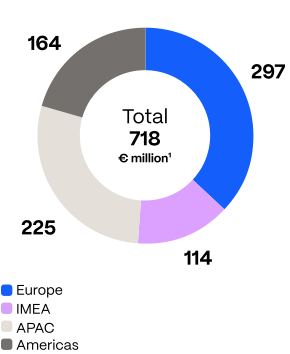
Adjusted EBITDA 2025
by segment
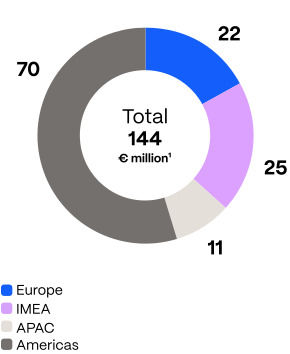
Net capex 2025
by segment
SIG aseptic filling machines 2025
by segment
Adjusted EBITDA
The following table reconciles profit or loss for the period to EBITDA and adjusted EBITDA.
(In € million) |
|
Year ended |
|
Year ended |
|
Non-recurring charges |
|
Year ended |
|---|---|---|---|---|---|---|---|---|
Profit/(loss) for the period |
|
194.5 |
|
208.3 |
|
(295.3) |
|
(87.0) |
Net finance expense |
|
143.1 |
|
126.3 |
|
|
|
126.3 |
Income tax expense |
|
86.5 |
|
95.6 |
|
(55.4) |
|
40.2 |
Depreciation and amortization |
|
419.5 |
|
340.6 |
|
|
|
340.6 |
EBITDA |
|
843.6 |
|
770.8 |
|
(350.7) |
|
420.1 |
Adjustments to EBITDA: |
|
|
|
|
|
|
|
|
Unrealized (gain)/loss on operating derivatives |
|
(9.6) |
|
5.9 |
|
|
|
5.9 |
Impairment losses |
|
21.3 |
|
1.3 |
|
261.9 |
|
263.2 |
Restructuring costs net of reversals |
|
9.9 |
|
1.3 |
|
8.7 |
|
10.0 |
Gain on sale of property plant and equipment and other assets |
|
(1.6) |
|
(5.0) |
|
|
|
(5.0) |
Transaction- and acquisition-related costs |
|
3.4 |
|
3.2 |
|
|
|
3.2 |
Change in fair value of contingent consideration |
|
(51.3) |
|
(3.7) |
|
|
|
(3.7) |
Other |
|
3.8 |
|
13.8 |
|
10.8 |
|
24.6 |
Adjusted EBITDA |
|
819.5 |
|
787.6 |
|
(69.3) |
|
718.3 |
Adjusted EBITDA decreased by €101.2 million, from €819.5 million in 2024 to €718.3 million in 2025. The adjusted EBITDA for the year ended December 31, 2025 was impacted by impairment losses and other non-recurring charges of €69.3 million described above. Excluding these non-recurring charges, adjusted EBITDA was €787.6 million, or €31.9 million lower than the prior year. At constant currency and excluding non-recurring charges, adjusted EBITDA increased 1.6% compared with the prior year. Improvements to adjusted EBITDA compared with 2024 were driven by price increases and lower raw material costs mostly due to a favourable polymer price environment.
In accordance with SIG’s definition of adjusted EBITDA, charges where regional management is held accountable for the delivery of returns on customer projects, such as filling line investments or new product launches, remain included as part of adjusted EBITDA. Impairment of intangible assets, impairment of production-related assets and restructuring costs are excluded from adjusted EBITDA.
Adjusted EBITDA margin1
|
|
As of |
|
As of |
|
As of |
||||
|---|---|---|---|---|---|---|---|---|---|---|
Europe |
|
28.7% |
|
31.9% |
|
29.5% |
||||
IMEA |
|
25.5% |
|
26.8% |
|
26.7% |
||||
APAC |
|
25.2% |
|
26.4% |
|
27.7% |
||||
Americas |
|
18.8% |
|
19.6% |
|
23.5% |
||||
Total |
|
22.1% |
|
24.2% |
|
24.6% |
||||
|
||||||||||
The adjusted EBITDA margin was 22.1% compared with 24.6% for 2024. Excluding the non-recurring charges, adjusted EBITDA margin was 24.2%. For 2025, the appreciation of the Euro, particularly against the Brazilian Real, Mexican Peso, US Dollar and Chinese Renminbi has reduced the adjusted EBITDA margin by 60 basis points. The adjusted EBITDA margin, excluding foreign currency fluctuations and excluding non-recurring charges was stable compared to the prior year.
Higher production costs reflected unabsorbed fixed costs and lower production efficiencies. SG&A costs were impacted by wage inflation and growth investments in the first half of the year, which slowed down in the second half of 2025.
SG&A as a percentage of revenue was 13.6% compared to 12.4% in 2024. Excluding non-recurring charges, SG&A was 12.0% of revenue. The cessation of the Onex PPA positively impacted SG&A by €31.3 million. R&D spend (excluding depreciation, amortization and impairment losses) remained stable as a percentage of revenue in 2025 at 2.2% (2024: 2.1%).
Compared to the prior year, segment adjusted EBITDA margins were influenced by the following third-party factors: In Europe margins were positively impacted by price and favorable customer mix due to export volumes. Positive pricing in IMEA was partially offset by currency headwinds. APAC was negatively impacted by product mix and higher SG&A. In the Americas, the decrease in margin was driven by unfavorable movements in foreign currencies, investments to enhance capabilities and wage inflation.
EBITDA decreased by €423.5 million to €420.1 million in 2025. Excluding the non-recurring charges, EBITDA decreased by €72.8 million to €770.8 million. The decrease was primarily related to the lower adjusted EBITDA, negative change in unrealized gains/losses on operating derivatives and a large positive change in the fair value of the contingent consideration that did not recur in the current year. These negative impacts were partially offset by the impairment losses and restructuring costs for the chilled carton production plant in China in the prior year.
EBIT
(In € million or %) |
|
Year ended |
|
Year ended |
|
Non-recurring charges |
|
Year ended |
||||
|---|---|---|---|---|---|---|---|---|---|---|---|---|
EBIT |
|
424.1 |
|
430.2 |
|
(350.7) |
|
79.5 |
||||
Adjustments to EBITDA1 |
|
(24.1) |
|
16.8 |
|
281.4 |
|
298.2 |
||||
PPA depreciation and amortization – Onex |
|
103.4 |
|
23.1 |
|
|
|
23.1 |
||||
PPA depreciation and amortization – Other acquisitions |
|
47.1 |
|
41.4 |
|
|
|
41.4 |
||||
Adjusted EBIT |
|
550.5 |
|
511.5 |
|
(69.3) |
|
442.2 |
||||
Adjusted EBIT margin |
|
16.5% |
|
15.7% |
|
|
|
13.6% |
||||
|
||||||||||||
Adjusted EBIT was impacted by higher depreciation relating to the new production plants in both India and China.
EBIT was positively impacted by the cessation of the Onex PPA amortization after the first quarter of 2025.
Net income
Adjusted net income in 2025 was €231.1 million (2024: €308.1 million). Excluding the non-recurring charges described above, adjusted net income was €285.3 million, €22.8 million below the prior year. This decrease was attributable to lower adjusted EBITDA and higher depreciation, which was partly offset by lower tax and finance expense.
The loss for the period was €87.0 million, driven by the non-recurring charges. Excluding those non-recurring charges, profit for the period was €208.3 million.
The effective tax rate in 2025 was impacted by the non-recurring charges described above and changed from 30.8% in 2024 to (86.0)%. The decrease reflected the relative mix of profits and losses taxed at varying tax rates in the jurisdictions SIG operates.
The adjusted effective tax rate increased from 27.7% in 2024 to 28.4% in 2025 (decreased to 27.2% excluding non-recurring charges).
The following table reconciles profit or loss for the period to adjusted net income.
(In € million) |
|
Year ended |
|
Year ended |
|
Non-recurring charges |
|
Year ended |
||||||
|---|---|---|---|---|---|---|---|---|---|---|---|---|---|---|
Profit/(loss) for the period |
|
194.5 |
|
208.3 |
|
(295.3) |
|
(87.0) |
||||||
Non-cash foreign exchange impact of non-functional currency loans and realized foreign exchange impact due to refinancing |
|
9.6 |
|
0.7 |
|
|
|
0.7 |
||||||
Amortization of transaction costs |
|
2.8 |
|
3.5 |
|
|
|
3.5 |
||||||
Net change in fair value of financing-related derivatives |
|
3.6 |
|
2.4 |
|
|
|
2.4 |
||||||
PPA depreciation and amortization – Onex acquisition1 |
|
103.4 |
|
23.1 |
|
|
|
23.1 |
||||||
PPA amortization – Other acquisitions |
|
47.1 |
|
41.4 |
|
|
|
41.4 |
||||||
Net effect of early repayment of loan |
|
1.6 |
|
– |
|
|
|
– |
||||||
Other |
|
1.3 |
|
– |
|
|
|
– |
||||||
Adjustments to EBITDA2 |
|
(24.1) |
|
16.8 |
|
281.4 |
|
298.2 |
||||||
Tax effect on above items |
|
(31.7) |
|
(10.9) |
|
(40.3) |
|
(51.2) |
||||||
Adjusted net income |
|
308.1 |
|
285.3 |
|
(54.2) |
|
231.1 |
||||||
|
||||||||||||||
Return on capital employed (ROCE)
The ROCE, determined at a reference tax rate of 30%, was 24.9% in 2025 (28.8% excluding non-recurring charges), compared with 26.6% in 2024. The year-on-year change is primarily due to the impairment losses of the current year, partially offset by lower ROCE EBITA.
The ROCE at the adjusted effective tax rate of 28.4% was 25.5% in 2025 (excluding non-recurring charges 29.9% at an adjusted effective tax rate of 27.2%).
(In € million) |
|
2025 |
|
2024 |
|---|---|---|---|---|
Income statement items |
|
|
|
|
Adjusted EBITDA |
|
718.3 |
|
819.5 |
Depreciation of PP&E and right-of-use assets |
|
(274.7) |
|
(267.6) |
Amortization of capitalized development and IT costs |
|
(3.1) |
|
(3.0) |
ROCE EBITA |
|
440.5 |
|
548.9 |
Balance sheet items |
|
|
|
|
Current assets (excl. cash and cash equivalents) |
|
867.8 |
|
938.1 |
Current liabilities (excl. interest-bearing liabilities) |
|
(1,256.5) |
|
(1,355.8) |
PP&E |
|
1,683.6 |
|
1,874.0 |
Right-of-use assets |
|
277.6 |
|
322.0 |
Capitalized development and IT costs |
|
20.6 |
|
25.1 |
Non-current deferred revenue |
|
(353.1) |
|
(360.0) |
Capital employed |
|
1,240.0 |
|
1,443.4 |
Pre-tax ROCE |
|
35.5% |
|
38.0% |
ROCE tax rate of 30% |
|
30.0% |
|
30.0% |
Post-tax ROCE at 30% tax rate |
|
24.9% |
|
26.6% |
Adjusted effective tax rate |
|
28.4% |
|
27.7% |
Post-tax ROCE at adjusted effective tax rate |
|
25.5% |
|
27.5% |
Capital expenditure
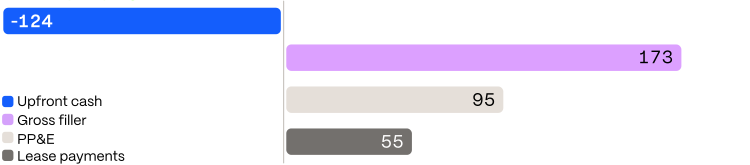
To better reflect the Group’s investments in production plants and production equipment via leases, management has updated its definition of capital expenditure to include lease payments. The following table presents capital expenditure with and without lease payments.
(In € million) |
|
Year ended |
|
Year ended |
||||
|---|---|---|---|---|---|---|---|---|
PP&E and intangible assets (net of sales1 and excluding filling lines and other related equipment) |
|
94.8 |
|
126.6 |
||||
Filling lines and other related equipment |
|
173.3 |
|
180.6 |
||||
Capital expenditure |
|
268.1 |
|
307.2 |
||||
Upfront cash |
|
(123.6) |
|
(143.3) |
||||
Net capital expenditure |
|
144.5 |
|
163.9 |
||||
Lease payments |
|
55.2 |
|
51.7 |
||||
Net capital expenditure, including lease payments |
|
199.7 |
|
215.6 |
||||
Net capital expenditure, incl. lease payments as a % of revenue |
|
6.1% |
|
6.5% |
||||
|
||||||||
Net capital expenditure, including lease payments decreased by €15.9 million to €199.7 million in 2025 (2024: €215.6 million), representing 6.1% of revenue (6.5% in 2024). The decrease reflected the completion of the production plant in India. This was offset by investments in the further expansion of the production plant in Mexico. Capital expenditure includes the proceeds from the sale of the former chilled production plant in China as well as land in Europe (€16.9 million).
Upfront cash received for filling lines, which is included in net cash from operating activities, was at a lower absolute level to the prior year and decreased as a percentage of filling line and other related equipment expenditure to 71% (2024: 79%). Upfront cash as a percentage of filling line and other related equipment expenditure can vary depending on the type of contract and location.
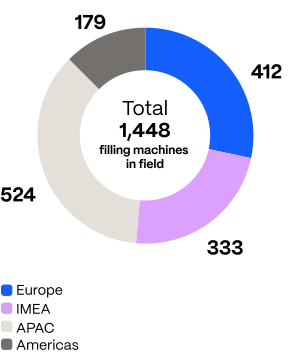
Despite the challenging market environment, SIG placed 68 aseptic carton filling machines in field in 2025 (75 in 2024). Taking account of withdrawals, the number of SIG aseptic carton filling machines globally reached 1,448 (1,434 in 2024), a net increase of 14. Some of the filling machines that were retired during the year will be overhauled and redeployed. In general, new filling machines placed in field have significantly higher capacity than retired filling machines.
NET CAPEX 2025
(€ million)
Cash flows
Net cash from operating activities decreased by €134.9 million from €649.2 million in 2024 to €514.3 million in 2025. The decease was primarily driven by lower EBITDA compared with the prior year, including unfavorable currency movements against the Euro and an increase in customer incentive payments for strong growth in 2024. This was partially offset by lower tax and interest payments of €38.2 million.
Net cash used in investing activities in 2025 decreased by €44.1 million compared to 2024. The movements in capital expenditure and cash inflows from sales of land are described under “Capital expenditure” above.
Free cash flow was €191.0 million compared with €290.3 million in 2024. The decrease in free cash flow was primarily driven by lower EBITDA compared with the prior year and an increase in customer incentive payments for strong volume growth in 2024.
The net cash used in financing activities of €183.1 million reflects dividends paid of €202.7 million, €78.1 million net increase in debt and €55.2 million of lease payments.
Net debt and leverage
(In € million) |
|
As of |
|
As of |
|---|---|---|---|---|
Gross debt |
|
2,498.1 |
|
2,474.9 |
Cash and cash equivalents |
|
354.3 |
|
(303.4) |
Net debt |
|
2,143.8 |
|
2,171.5 |
Net leverage ratio |
|
3.0x |
|
2.6x |
Net leverage as of 2025 was 3.0x (2024: 2.6x). The net debt as of December 31, 2025 broadly remained at the same level as of December 31, 2024. The adjusted EBTIDA performance negatively impacted the net leverage ratio.
The Group’s debt covenants stipulate a net leverage ratio of no more than 4.0x, reported bi-annually. The calculation is based on net debt to adjusted EBITDA, excluding asset impairments. Based on this calculation, the leverage ratio as of December 31, 2025 was 2.8x.
Debt rating
|
|
Company rating |
|
Outlook |
|
As of |
|---|---|---|---|---|---|---|
Moody’s |
|
Baa3 |
|
Stable |
|
March 2025 |
S&P |
|
BBB- |
|
Stable |
|
March 2020 |
Other
Dividend
As announced on September 18, 2025, the Board of Directors has decided to pause the dividend payment for the year ended December 31, 2025, and will therefore not propose a distribution of a dividend at its 2026 Annual General Meeting to be held on April 16, 2026.
A dividend of CHF 0.49 per share, totaling CHF 187.3 million (€202.7 million), was paid to shareholders from the capital contribution reserve (additional paid-in capital) in April 2025. A dividend of CHF 0.48 per share, totaling CHF 183.5 million (€187.8 million), was paid from the capital contribution reserve in April 2024.
Foreign currencies
We operate internationally and transact business in a range of currencies. Whilst our reporting currency is the Euro, we generate a significant portion of our revenue and costs in currencies other than the Euro. Changes in the value of the Euro against other currencies in countries where we operate can affect our results and the value of balance sheet items denominated in foreign currencies. Our strategy is to reduce this exposure through the natural hedging that arises from the localisation of our operations. In addition, we systematically hedge all key currencies against the Euro using a twelve-month rolling layered approach.
We supply semi-finished and finished goods to certain of our non-European operations in Euros, and a number of our key raw material suppliers charge us for raw materials in Euros or US Dollars. As a result, a greater portion of our costs is denominated in Euros and, to a lesser extent, US Dollars compared with the related revenue generated in those currencies. Accordingly, changes in the exchange rates of the Euro and the US Dollar compared with the currencies in which we sell our products could adversely affect the results of operations. We expect to mitigate some of these cost mismatches through the opening and expansion of local production facilities in certain markets, ongoing efforts to qualify local suppliers and by using foreign currency derivatives.
2026 guidance
The Company expects total revenue growth at constant currency and constant resin for 2026 to be within a range of 0–2%. This reflects a similar market environment as in 2025.
The adjusted EBIT margin is expected to be between 15.7% and 16.2%.
Guidance is subject to input costs and foreign currency volatility.
Net capital expenditure, including lease payments, is projected to be within the range of 6–8% of revenue.
The adjusted effective tax rate is forecast to be between 26% and 28%.
Mid-term guidance
The Company expects revenue growth of 3–5%, at constant currency and constant resin, assuming a normalization of market conditions in the medium term. The adjusted EBIT margin is expected to be above 16.5% in the medium term.
Net capital expenditure, including lease payments, is expected to be in the range of 6–8% of revenue, whilst ensuring that investments are made in the most accretive areas.
Net leverage is expected to reach 2.5x by 2027, with further improvement to around 2.0x in the medium term.
After the pause in the dividend payment for the year ended December 31, 2025, the Company expects to re-instate dividends for the year ending December 31, 2026 with a payout ratio of 30–50% of adjusted net income.
Alternative performance measures
Definitions of the alternative performance measures used by SIG management and their related reconciliations are posted under the following link: Alternative performance measures
Additional information about alternative performance measures used by SIG management is included in the consolidated financial statements for the year ended December 31, 2025.