Compensation framework for the Group Executive Board
Compensation overview for the Group Executive Board
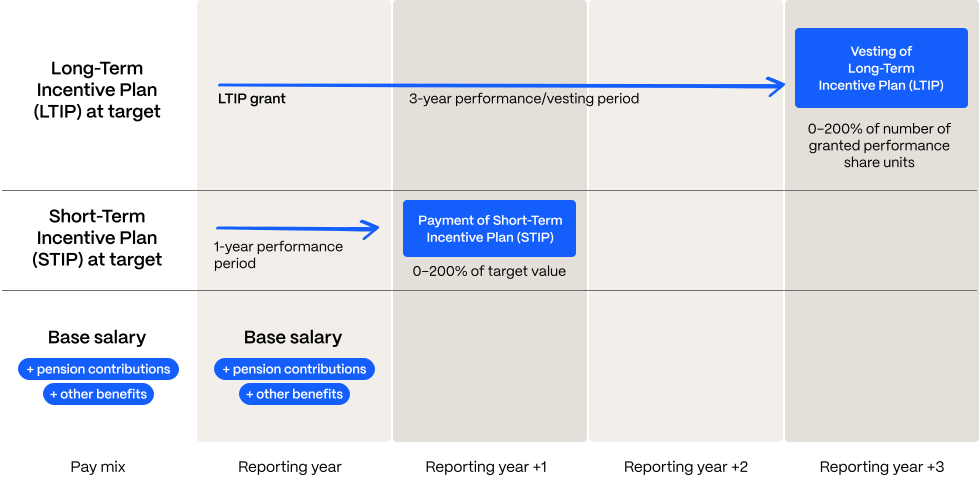
Compensation for the members of the Group Executive Board is provided through the following main components: an annual base salary and pension benefits/other benefits, which together form the fixed compensation component; a Short-Term Incentive Plan (“STIP”) and a Long-Term Incentive Plan (“LTIP”), which together form the variable compensation component (see Figure 10).
Figure 10: Illustrative overview of the compensation framework of the Group Executive Board in 2025.
Fixed compensation components:
Annual base salary
The base salary is the main fixed compensation component paid to the members of the Group Executive Board at SIG. It is paid in cash in 12 equal monthly installments unless local law requires otherwise. The level of base salary is determined by the Board of Directors taking into account the specific role performed, and the responsibilities accepted within that role. It rewards the experience, expertise and know-how necessary to fulfil the demands of a specific position. In addition, the market value of the role in the location where the Company competes for talent is considered.
Pension benefits and other benefits
As the Group Executive Board is international in its nature, the members participate in the benefit plans available in the country of employment. Benefits mainly include insurance and health care plans as well as pension coverage, where applicable. SIG’s pension benefits for members of the Group Executive Board employed under a Swiss employment contract exceed the legal requirements of the Swiss Federal Law on Occupational Retirement, Survivors’ and Disability Pension Plans (BVG) and are in line with the benefits offered by other international companies. Members of the Group Executive Board who are under a foreign employment contract are insured commensurately with market conditions and with their positions. The plans vary in accordance with the local competitive and legal environment and are structured in accordance with local practice and in line with local legal requirements.
In line with general market practice and Swiss law, new members joining the SIG Group Executive Board may be granted replacement awards to compensate for any resulting forfeited compensation at prior employers. Such replacement awards are structured on a “like-for-like” basis regarding instrument and performance conditions and never exceed the forfeited amount at the prior employer, which is verified based on written documentation provided by the recipient and, where needed, a third-party validation of the forfeiting value. If applicable, replacement awards are reported accordingly in the compensation table for the relevant financial year. In the reporting year, no replacement award has been granted.
In addition, the Group Executive Board members receive certain executive perquisites and benefits in kind according to competitive market practice in the country of their employment (e.g. company cars) as well as cash premiums on share-based payments according to local law. The fair value of these benefits is disclosed in Table 3.
Variable compensation components:
The variable compensation consists of a short-term incentive and a long-term incentive component.
Short-Term Incentive Plan (“STIP”)
Under the STIP, the members of the Group Executive Board are rewarded for the achievement of pre-defined annual targets for multiple key performance indicators (“KPIs”), including financial aspects (for details see Figure 11) as well as an ESG element. In deviation to 2024, for 2025, the Board of Directors replaced the adjusted EBITDA target by an adjusted EBIT and adjusted EBIT margin, on group as well as regional level. Adjusted EBIT is weighted with 30% while EBIT margin is weighted with 20%.
The ESG KPI criteria in the STIP underpins the ongoing commitment to sustainability rooted in SIG’s business strategy and activities. The assessment of achievements relating to the ESG element is based on the Company’s EcoVadis score, enabling an objective and independent measurement approach. Essentially, EcoVadis assesses the quality of a company’s sustainability management system through its policies, actions and results.
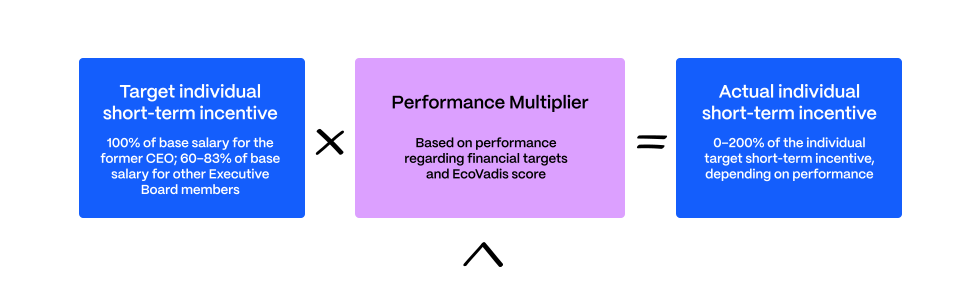
Every year and for each Group Executive Board member, the Board of Directors determines, based on a proposal by the Compensation Committee, an individual target amount under the STIP as a percentage of each member’s base salary, which is paid out if the targets for the KPIs are achieved at 100%. To determine the actual payout under the STIP, the performance of each KPI is assessed individually against pre-determined targets and is expressed as a target achievement rate in a range from 0% to 200% and then combined according to the assigned weightings (see Figure 11). The overall payout is capped at 200% of the target amount and can fall to zero should the minimum performance achievement level for each KPI not be attained. In exceptional cases, the actual payout under the STIP can be adjusted as proposed by the Compensation Committee and approval by the Board. Detailed information regarding the target amounts, KPI targets and achievements of those targets is provided in the section “Short-Term Incentive Plan 2025” further below.
Group Executive Board members with regional responsibilities have KPIs reflecting their regional as well as Group performance. To strengthen the focus of members with regional responsibility on their region’s KPIs, the weighting of regional targets is set at 60%, while the weighting of Group KPIs is 40%.
For other Group Executive Board members with a primary Group Function focus, including the CEO and the CFO, performance is assessed based on Group performance only. The framework is illustrated in Figure 11.
Figure 11: Overview of the Group Executive Board STIP compensation framework in 2025.
|
|
KPIs |
|
Weight 2025 |
|
Members of the Group Executive Board without regional responsibility |
|
Members of the Group Executive Board with regional responsibility |
|---|---|---|---|---|---|---|---|---|
Group |
|
Group adjusted EBIT |
|
30% |
|
100% |
|
40% |
|
Group adjusted EBIT margin |
|
20% |
|
|
|||
|
Group revenue |
|
20% |
|
|
|||
|
Group free cash flow |
|
20% |
|
|
|||
|
EcoVadis score (sustainability metric) |
|
10% |
|
|
|||
Regional |
|
Regional adjusted EBIT |
|
30% |
|
|
|
60% |
|
Regional adjusted EBIT margin |
|
20% |
|
|
|||
|
Regional revenue |
|
30% |
|
|
|||
|
Regional free cash flow |
|
20% |
|
|
The Chief Markets Officer also acts as President of Bag-in-Box and Spouted Pouch. To take account of this responsibility, the short-term incentive compensation for this position is calculated on 60% Group targets and 40% Bag-in-Box and Spouted Pouch targets, as an exception to the framework illustrated in Figure 11.
Long-Term Incentive Plan (“LTIP”)
The LTIP offers eligible employees the opportunity to participate in the long-term success of SIG, thereby reinforcing their focus on longer-term performance and aligning their interests with those of shareholders. The following provides an outline of the plan specifics.
The mechanics behind the LTIP are illustrated in Figure 12. At the beginning of each three-year vesting period, a certain number of performance share units (“PSUs”) is granted to each participant, which represents a contingent entitlement to receive SIG shares in the future. The number of granted PSUs depends on (i) the individual LTIP grant level in CHF, determined by the Board each year but never exceeding 204% of the base salary of any member of the Group Executive Board, including the former CEO, and (ii) the reference price of one PSU. The reference price reflects the 20-day volume-weighted share price before the grant date.
Figure 12: Overview of the principles of the LTIP.
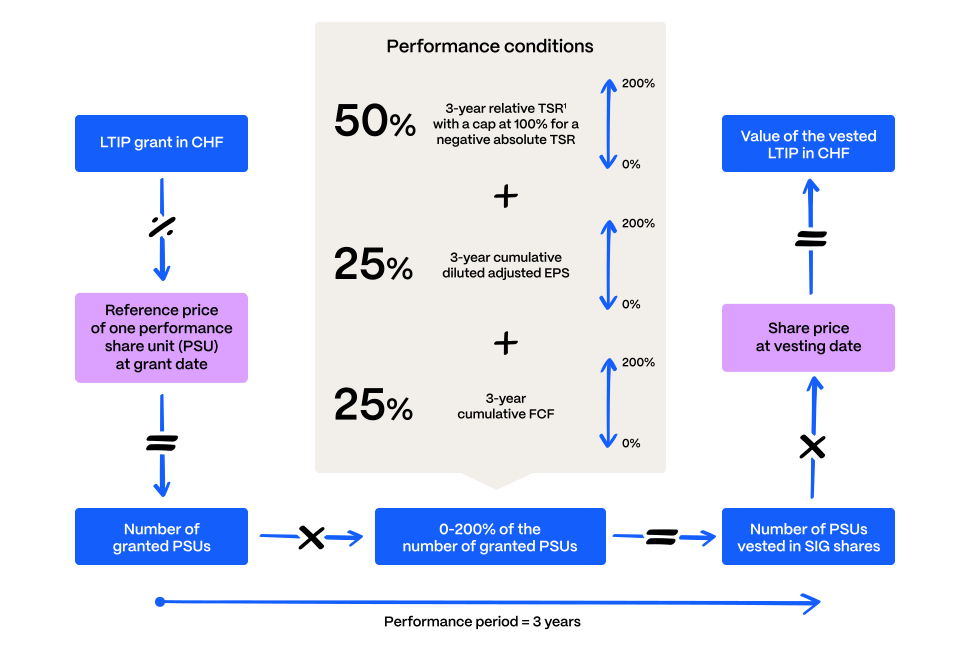
After the three-year vesting period, a certain number of the granted PSUs vest, depending on the performance of SIG during that period. The number of PSUs vested in SIG shares may vary between 0% and 200% of the granted PSUs and is based on the achievement of the following three weighted KPIs.
KPIs |
|
Relative total shareholder return (rTSR) |
|
Diluted adjusted earnings per share (EPS) |
|
Free cash flow (FCF) |
|---|---|---|---|---|---|---|
Weight |
|
50% |
|
25% |
|
25% |
Description |
|
Total shareholder return measured relative to the SMI MID (SMIM) Total Return2 |
|
SIG’s cumulative diluted adjusted earnings per share |
|
SIG’s cumulative free cash flow |
To determine the multiple of the granted PSUs ultimately vesting into SIG shares, the performance against each KPI is assessed individually in a range from 0% to 200% and then combined according to the assigned weightings. This means that a low performance on one performance measure can be balanced by a higher performance on another performance measure. Overall, the combined vesting multiple will never exceed 200%. If the performance on each of the three KPIs lies below the respective minimum performance requirement, the resulting combined vesting multiple is 0% and consequently no granted PSUs vest. Furthermore, if the absolute TSR falls below zero over the relevant performance period, the vesting factor of the relative TSR metric would be capped at 100%. Detailed information about the grants, targets and their achievements are provided in the section “Long-Term Incentive Plan 2025” further below.
Since the introduction of the LTIP in 2019, PSUs have been granted to the members of the Group Executive Board and selected other senior members of management on a yearly basis. For an overview of the annual PSU allocations and the outstanding PSUs, see note 30 of the consolidated financial statements for the year ended December 31, 2025 as well as the respective shareholding overview in this report.
In addition to failure to meet the threshold performance level, other circumstances under which no PSUs vest include various forfeiture clauses relating to termination of employment during the vesting period of the LTIP.
The LTIP awards are subject to a clawback provision. In the event of a financial restatement due to a material non-compliance of the Company with applicable financial reporting requirements, or in the event of fraudulent behavior or other willful misconduct by a plan participant, the Board of Directors may review the specific facts and circumstances and take clawback actions.
The Board has the right to allocate other, potentially non-recurring, equity-based awards to employees. Any such awards allocated to members of the Group Executive Board are reported accordingly in the compensation table for the relevant financial year.
One-time Leadership Continuity Plan
In light of the Company’s ongoing transformation and recent leadership changes, the Board of Directors, upon recommendation of the Compensation Committee, approved a targeted, one-time Leadership Continuity Plan in 2025. The Plan is designed to safeguard execution of the Company’s strategic priorities during a period of heightened change and to retain individuals in roles critical to operational and strategic stability. The award consists of restricted share units (“RSUs”) granted in October 2025 to a defined core leadership team, including members of the Group Executive Board. The RSUs are subject to a service and restriction period and will convert into shares after three years, thereby reinforcing retention and alignment with shareholders during this transformation phase.
Compensation mix
Figure 13 illustrates the compensation mix for the former CEO and the Group Executive Board at target level in 2025. This compensation mix reflects SIG’s high-performance orientation and represents the Company’s strong emphasis on aligning the interests of the Group Executive Board and shareholders to create long-term shareholder value, by making a large part of compensation dependent on the achievement of long-term goals.
Figure 13: Overview of the compensation mix for the former CEO and the Group Executive Board (excl. former CEO) at target level in 2025.
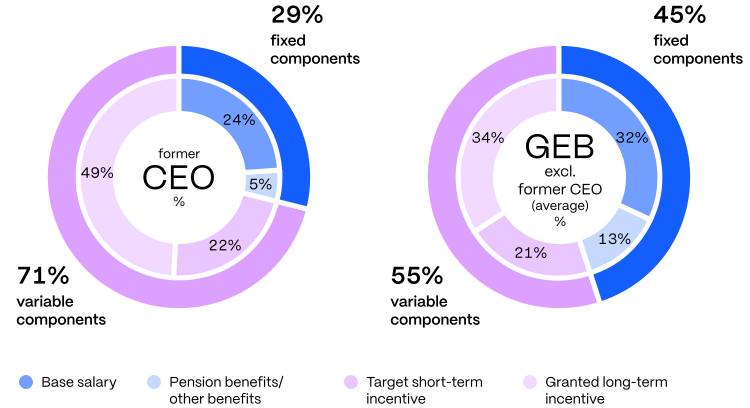
For the Group Executive Board members excluding the former CEO, the fixed components (annual base salary and pension benefits/other benefits, excluding any one-off items) vary between 39% and 55% (45% on average) of the total target compensation and the variable components vary between 45% and 61% (55% on average) of total regular target compensation (without any one-off compensation elements) in 2025.
Holistic approach to align performance and long-term orientation of the compensation structure
SIG’s compensation framework is designed to align with its values of accountability, long-term growth and ethical leadership. Accordingly, the higher portion of compensation for the members of the Group Executive Board is variable and performance-based, with 71% for the former CEO and 55% of total regular target compensation for other members of the Group Executive Board on average. This ensures that remuneration is closely linked to delivery of tangible results that drive sustainable growth without promoting excessive risk-taking. SIG believes that this approach encourages performance differentiation and excellence among the members of the Group Executive Board for the benefit of the Company and its stakeholders.
The compensation design principles at SIG are long-term oriented with a substantial portion of the overall compensation based on the LTIP. The share-based variable compensation is deferred for three years which is in line with the long-term horizon of the business strategies. The Company believes that this underpins the strong focus on long-term orientation. By integrating these perspectives into the compensation framework, the Company aims to establish alignment and foster a culture of responsible leadership and shared success. The design principles demonstrate the Company’s commitment to delivering consistent and enduring value to its shareholders.
Employment conditions for the Group Executive Board
All members of the Group Executive Board have employment contracts of unlimited duration and a notice period of 12 months, ensuring compliance with applicable laws and regulations. The employment contracts may provide, for a period of up to one year, post-termination compensation for adherence to non-compete clauses. Payment for the non-compete period, if any, amounts to a maximum of one year’s compensation, but in any event no more than the average compensation of the respective member during the three preceding financial years, unless otherwise required by local law. Such contracts do not include any contractual severance payments or any change of control provisions other than accelerated vesting and/or unblocking of unvested share awards from the LTIP.
In the event of a change of control, the LTIP will be terminated while settling contractual claims as of the date of the change of control (which will be defined by the Board if unclear). There are generally no special arrangements in place from which Group Executive Board members (as well as Board members) could benefit in divergence from other plan participants.
Compensation awarded to the Group Executive Board (audited)
Table 3 summarizes the total compensation for the nine members of the Group Executive Board active during 2025. The total regular compensation for the Group Executive Board amounted to CHF 14.6 million. This amount includes CHF 2.5 million (including full LTIP grant as of April 1, 2025 which was partly forfeited due to the exit agreement signed) relating to payments to the former CEO, Samuel Sigrist, who ceased to be CEO and member of the Group Executive Board on August 2, 2025. Ann-Kristin Erkens was appointed interim CEO, in addition to her current role as CFO.
Table 3: Total compensation of the Group Executive Board in 2025, including figures for the prior year.
CHF1 gross amounts |
|
Group Executive Board (including the former CEO) 2025 |
|
Group Executive Board (including the former CEO) 2024 |
|
Highest payment 2025 Samuel Sigrist |
|
Highest payment 2024 Samuel Sigrist |
||||||||||||||||||||
|---|---|---|---|---|---|---|---|---|---|---|---|---|---|---|---|---|---|---|---|---|---|---|---|---|---|---|---|---|
Annual base salary |
|
3,257,957 |
|
3,132,065 |
|
408,333 |
|
700,000 |
||||||||||||||||||||
Pension benefits |
|
463,746 |
|
499,985 |
|
75,040 |
|
124,760 |
||||||||||||||||||||
Short-term variable compensation2 |
|
2,132,874 |
|
2,204,784 |
|
408,334 |
|
603,120 |
||||||||||||||||||||
Long-term variable compensation (granted)3 |
|
6,361,3674 |
|
4,028,750 |
|
1,425,000 |
|
1,425,000 |
||||||||||||||||||||
Other benefits5 |
|
1,248,3176 |
|
524,966 |
|
19,075 |
|
40,772 |
||||||||||||||||||||
Social security contributions7 |
|
1,094,720 |
|
677,585 |
|
165,685 |
|
216,317 |
||||||||||||||||||||
Total regular compensation |
|
14,558,981 |
|
11,068,134 |
|
2,501,468 |
|
3,109,969 |
||||||||||||||||||||
Payments to former executives |
|
688,8059 |
|
242,2258 |
|
688,8059 |
|
– |
||||||||||||||||||||
Accruals for non-compete agreements |
|
759,500 |
|
– |
|
759,500 |
|
– |
||||||||||||||||||||
Total compensation |
|
16,007,286 |
|
11,310,359 |
|
3,949,773 |
|
3,109,969 |
||||||||||||||||||||
|
||||||||||||||||||||||||||||
Approved versus total regular compensation for the Group Executive Board
The total compensation for the Group Executive Board for 2025 is CHF 16.0 million (including social security contributions), which is below the maximum aggregate compensation amount of CHF 18.0 million approved for 2025 at the Annual General Meeting on April 23, 2024.
The personnel change in the Group Executive Board in 2025 led to a forfeiture of 132,817 PSUs out of the 2023, 2024 and 2025 grants, representing a total value (at grant fair value) of CHF 2.5 million.
Short-Term Incentive Plan (“STIP”) 2025
In 2025, the individual short-term incentive target amount equals 100% of the base salary for the former CEO and lies between 60% and 83% of the respective base salaries for other members of the Group Executive Board.
The threshold, target and cap (together the “targets”) for both the financial KPIs and the ESG KPI are determined by the Board, based on the recommendation of the Compensation Committee each year following a well-established process. To calibrate the achievement curve for financial KPIs, in general a financial target achievement level is identified based on the budget of the respective year. Minimum and maximum performance achievement levels are defined taking various factors into consideration, including the previous year’s performance level as well as the notion that higher payouts should require proportionally higher levels of performance achievement. This leads to more ambitious target curves to achieve the maximum payout. In line with this, achieving the target payout for the ESG KPI requires an improvement in the Company’s EcoVadis score, thereby aligning compensation with the Company’s ambition to remain a leader in ESG matters.
Figure 14 illustrates the targets set for the financial year 2025, including threshold and cap for the payout.
Figure 14: Target setting for the Short-Term Incentive Plan for the financial year 2025.
Performance measures |
|
Weight |
|
Threshold |
|
Target |
|
Cap |
||||
|---|---|---|---|---|---|---|---|---|---|---|---|---|
Group adjusted EBIT |
|
30% |
|
544.3m EUR |
|
567.0m EUR |
|
601.1m EUR |
||||
Group adjusted EBIT margin |
|
20% |
|
15.7% |
|
16.4% |
|
17.4% |
||||
Group revenue first half year (growth) |
|
6% |
|
-2.4% |
|
-0.4% |
|
2.6% |
||||
Group revenue ful year (growth) |
|
14% |
|
2.1% |
|
4.2% |
|
7.3% |
||||
Group free cash flow |
|
20% |
|
227.4m EUR |
|
249.9m EUR |
|
283.7m EUR |
||||
EcoVadis score1 |
|
10% |
|
86 points |
|
96 points |
|
98 points |
||||
|
||||||||||||
Considering the soft market conditions, updated growth forecasts and the strategy review, the Group recognized impairment losses and other non-recurring charges in the second half of 2025. As a result, all financial KPIs for the full year were missed.
For the sustainability metric, the EcoVadis score1, the company achieved a record score of 99/100 in 2025 and was awarded with the platinum medal for the seventh consecutive year, again placing the Company in the top 1% of companies assessed. For the second year in a row, SIG scored 100/100 in both Environment and Labor & Human Rights. Please refer to the Sustainability section of our Annual Report for details on our sustainability performance and EcoVadis platinum rating.
The achievement based on the initially set targets is outlined in Figure 15.
Figure 15: 2025 performance at Group level relevant for STIP performance assessment.
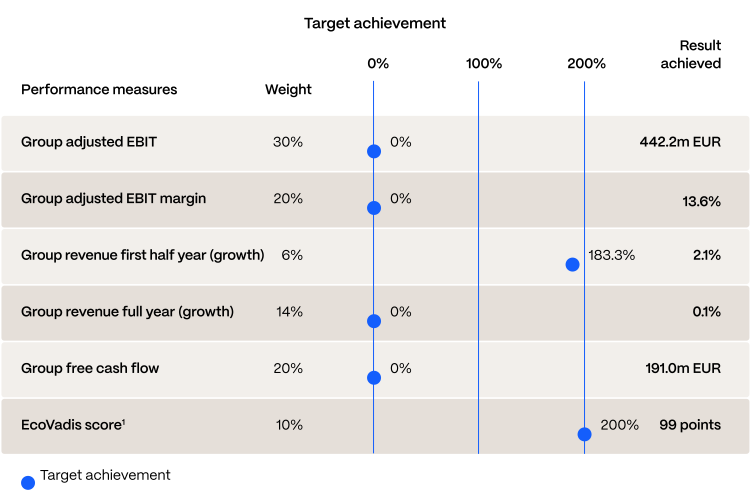
To appropriately reflect the exceptional circumstances in 2025 and management’s contributions during this period, the Board of Directors determined that any STIP payout for members of the Group Executive Board would be assessed on a discretionary basis. This approach was adopted to ensure that outcomes adequately reflect performance in a year marked by significant transformation and factors that were not fully captured by the pre-defined formulaic metrics. In exercising its discretion, the Board considered a balanced set of internal quantitative and qualitative criteria, including progress against key operational and financial priorities as well as transformation initiatives aimed at strengthening the Company’s long-term positioning.
The overall payout for the 2025 STIP corresponds to 90.0% for the interim CEO (86.2% to the former CEO in 2024) and between 70.0% and 90.0% for the other members of the Group Executive Board (41.9% to 148.8% in 2024).
1 The EcoVadis score is a third-party assessment of our environmental, social and governance performance, measured relatively.
Long-Term Incentive Plan (“LTIP”) 2025
In 2025, the LTIP grant in CHF amounted to 204% of the base salary for the former CEO and was between 74% and 158% of the respective base salaries for other members of the Group Executive Board.
The threshold, target and cap (together the “targets”) performance levels for the three LTIP performance measures for the 2025 grant are illustrated in Figure 16 and were set by the Board, based on the recommendation of the Compensation Committee applying a robust, stringent approach supported by HCM International Ltd. The vesting curves for each KPI under the LTIP are defined to support balanced performance and payout situations below and above the target and allow for a realistic performance-related chance to realize vesting.
Figure 16: Overview of the vesting curve of the LTIP 2025.
Performance measures |
|
Weight |
|
Threshold |
|
Target |
|
Cap |
|---|---|---|---|---|---|---|---|---|
3-year total shareholder return measured relative to the SMI MID (SMIM) Total Return |
|
50% |
|
–16% of index |
|
–0% compared with index |
|
+10% of index |
3-year cumulative diluted adjusted earnings per share |
|
25% |
|
64.4% of target |
|
100% target as set by the Board of Directors |
|
135.6% of target |
3-years cumulative free cash flow |
|
25% |
|
83.0% of target |
|
100% target as set by the Board of Directors |
|
117.0% of target |
Given the market sensitivity of the diluted adjusted earnings per share (EPS) and FCF targets, and the fact that the plan runs until 2028, the targets for these measures are disclosed on a relative basis. Investors’ return expectations on market value, stock risk profile, investment projections and current profitability levels were taken as a starting point and translated into EPS and FCF targets, using multifactor valuation models and statistical analyses in order to establish an appropriate link between LTIP payouts and the value created for investors. The results of the outside-in approach were assessed against historical company performance, as well as equity analysts’ expectations and the strategic plan as approved by the Board, in order to reinforce the Compensation Committee’s and Board’s confidence in the overall quality and robustness of the EPS and FCF targets. The Compensation Committee discussed different options for target setting and the corresponding vesting curves for each performance measure and submitted a recommendation to the Board, which approved the respective vesting curves for the LTIP 2025 grant.
The 2022 LTIP grant vested on April 1, 2025 with a 26% payout. This reflects below-target achievement of all three performance measures. The composition of the total vesting multiple is illustrated in Figure 17.
Figure 17: Vesting multiple of the performance share unit grant 2022 for the period 2022 to 2025.
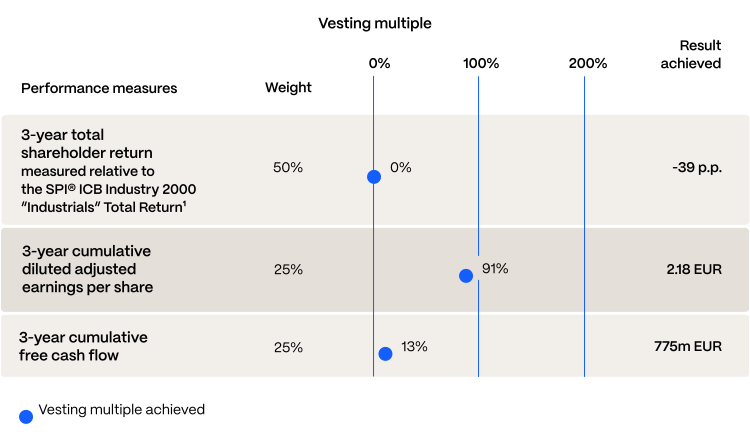
The Compensation Committee has defined a robust process to assess the materiality of major events, such as acquisitions completed during the three-year performance period of the plan. Based on the assessment, results achieved are adjusted to consider the influence of these events.
One-time Leadership Continuity Plan:
In 2025, the one-time individual RSU grants amounted to 50–60% of the respective annual base salaries for the members of the Group Executive Board, including the interim CEO.
For an overview of the 2025 equity grants and outstanding equity awards, please refer to note 30 of the consolidated financial statements for the year ended December 31, 2025 as well as the respective shareholding overview in this report.
Assessment of actual compensation paid/granted to the Group Executive Board
In comparison with the previous year, the total regular compensation of the entire Group Executive Board increased by 31.5%. The overall movement is mainly driven by the changes to the Group Executive Board and grants made under the one-time Leadership Continuity Plan and exchange rate movements.
Impact of personnel changes in the Group Executive Board:
In the prior year, the Group Executive Board was not fully staffed throughout the entire period, which affected the comparability of the reported figures. In addition, the composition of the Group Executive Board changed during the reporting period again. Following the departure of the former CEO, the CFO assumed the position of interim CEO from August 2025. Considering the expanded responsibilities, the CFO received proportionate additional remuneration for the duration of the interim mandate. These transitional arrangements led to temporary overlaps and impacted on the reported compensation figures for the reporting period.
Impact of currency exchange rates:
Four members of the Group Executive Board received their compensation in foreign currencies in 2025. For disclosure purposes, these amounts have been tanslated into Swiss francs. Reported figures therefore reflect exchange rate movements, while compensation in local currency increased marginally to offset inflation. This results in minor differencies compared with the previous reporting period.
Figure 18 illustrates the actual compensation mixes for the former CEO and the Group Executive Board in 2025, highlighting the strong focus on short- and long-term variable compensation elements.
Figure 18: Overview of the actual compensation mix in 2025 for the former CEO and the Group Executive Board excl. former CEO (reflects the amount granted under the LTIP).
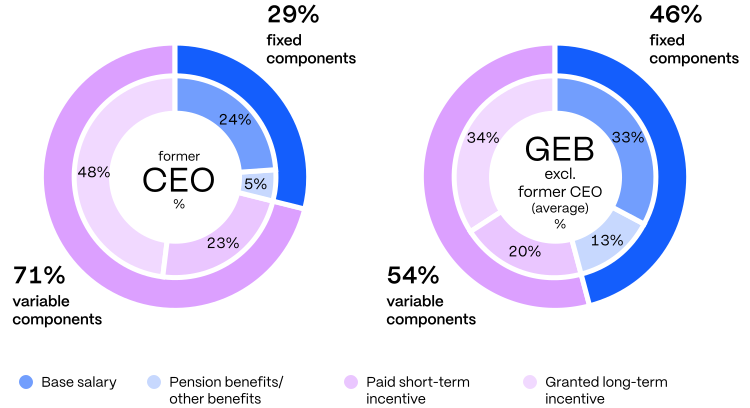
For the Group Executive Board members excluding the former CEO, the fixed components (annual base salary and pension benefits/other benefits, excluding any one-off items) vary between 40% and 49% (46% on average) of the total compensation paid and the variable components vary between 51% and 60% (54% on average) of total regular compensation paid (without any one-off compensation elements) in 2025.