Our sustainable packaging journey
At SIG, sustainability has long been central to our strategy – from responsible sourcing to world-first innovations, we are actively designing packaging systems that contribute to a regenerative future.
Our aseptic carton, bag-in-box, and spouted pouch solutions are designed to reduce food waste, lower energy and resource use, and expand access to nutrition – especially in regions with limited cold chain infrastructure.
We are the only company offering aseptic technology across all three formats. Aseptic packaging does not require constant refrigeration during storage or transport, eliminating the need for energy-intensive cold chains. When combined with a low pack-to-product ratio, a lightweight, resource-efficient design and produced with renewable electricity, our standard packaging solutions consistently outperform alternatives with similar functionality across key environmental indicators.
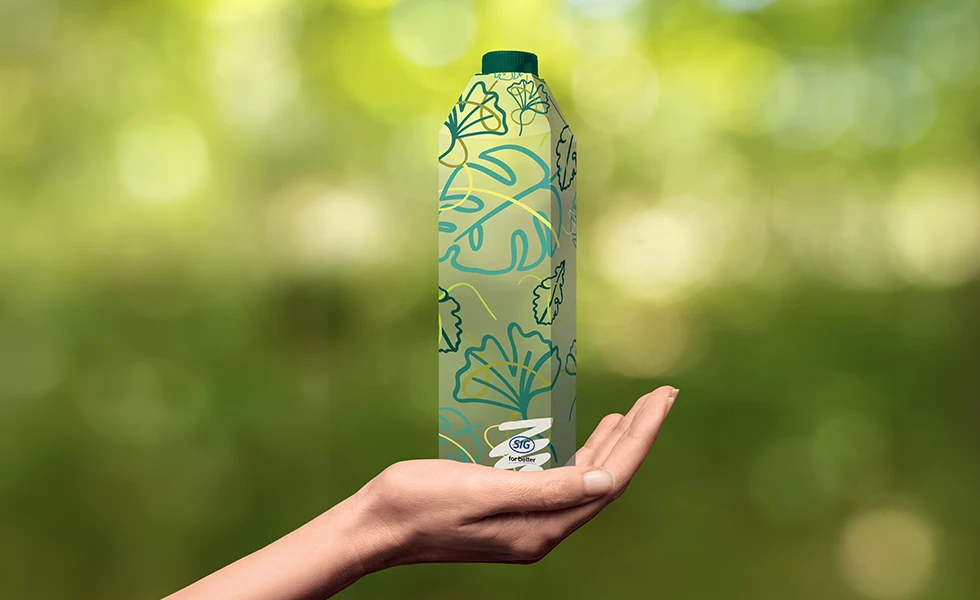
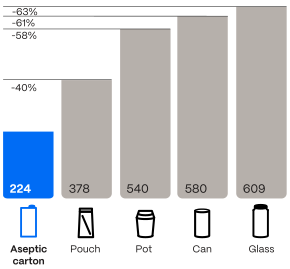
Independent life-cycle assessments (LCAs) show that our cartons, produced with renewable raw materials, outperform other packaging options1:
1 Based on life-cycle assessments for Europe using the ISO 14040 and ISO 14044 international standards and critically reviewed by an independent expert panel.
Aseptic Cartons
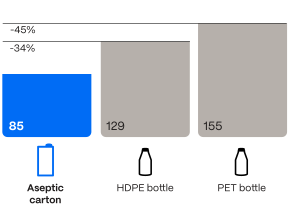
Liquid dairy
kg CO2 equivalent per packaging required for 1,000 liters UHT milk
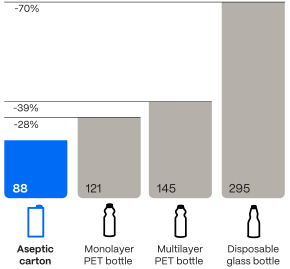
Non-carbonated soft drinks
kg CO2 equivalent per packaging required for 1,000 liters non-carbonated soft drinks
Food
kg CO2 equivalent per packaging required for 1,000 liters food
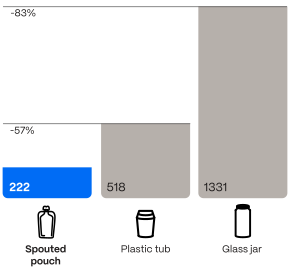
A recent LCA study2 we conducted for the United States market, confirming our 2024 European study, proves that our spouted pouches outperform alternative packaging delivering similar functionality.
2 Based on life-cycle assessments using the ISO 14040 and ISO 14044 international standards and critically reviewed by an independent expert panel for an average SIG Terra Spouted Pouch CB-100738 for the United States.
Spouted pouches: fruit purée
kg CO2 equivalent per packaging required for 1,000 kilograms of fruit purée
With our SIG Terra solutions, we are driving even deeper reductions in climate emissions, further increasing renewable and recycled feedstock3 use and paving the way to easier recycling. Our SIG Terra Alu-free + Full barrier aseptic carton material unlocks even greater sustainability gains – and we are setting a new standard by rapidly scaling availability to maximize impact.
3 Renewable and recycled polymers are linked to tall oil and post-consumer recycled plastics through certified mass balancing.
2010
SIG Terra Alu-free4
-
World’s first packaging material for aseptic cartons with no aluminum layer.
-
82% renewable paperboard.5
-
Up to 23% less carbon than standard SIG packaging material for aseptic cartons.6
-
For use with dairy products.

2013
SIG Dome7
Looks and pours like a bottle.
Environmental benefits of a carton.
2016
RS structure
Reduces plastic use while improving the robustness of our aseptic cartons during processing and distribution.
2017
SIG Terra Alu-free + Forest-based polymers8
World’s first aseptic carton with all main materials linked to forest-based renewable resources.9
No aluminum foil layer.
Up to 63% less carbon than standard SIG packaging material for aseptic cartons.6
For use with dairy products.
2018
SIG Terra Forest-based polymers10
Polymers linked to renewable resources.9
Ultra-thin aluminum foil layer to protect oxygen-sensitive products, such as orange juice.
Up to 41% less carbon than standard SIG packaging material for aseptic cartons.6
2019
Paper straw solution
World’s first paper straw for use with aseptic carton packs.
Straight, U-shaped, and telescopic options.
FSC™ Mix certified.
2019
ASI-labeled packs
World’s first aseptic carton packaging materials with ASI aluminum foil.
First product with ASI aluminum foil.
First, and only cartons globally that can carry the ASI Responsible Aluminium Sourcing logo.
2020
SIG Terra Circular polymers11
World’s first aseptic carton solution offered with post-consumer recycled content.
Polymers linked to post-consumer recycled plastics.12
2022
Bag-in-box and spouted pouch solutions join our portfolio
High product-to-packaging ratio and evacuation rates.
Less carbon than alternatives, such as plastic and glass bottles, tubs and jars.13
Recycle-ready mono-material spouted pouch.
First APR recognized recycle- ready bag-in-box.
World’s first bag-in-box linked to recycled content.
2023
SIG Dome Mini
Portion size.
Looks and pours like a bottle.
Environmental benefits of a carton.
2023
SIG Terra Alu-free + Full barrier commercially available
World’s first full barrier solution for aseptic cartons with no aluminum foil layer initially available in portion-size.
Up to 25% less carbon13 than standard SIG packaging material for aseptic cartons.
2025
Recycle-ready bag-in-box for wine
World’s first APR14-recognized bag-in-box for wine.
2025
SIG Terra Alu-free + Full barrier available in family-size
World’s first full barrier solution for aseptic cartons in family-size with no aluminum foil layer.
Up to 61% less carbon13 than standard SIG packaging material for aseptic cartons when linked to forest-based polymers12.
Up to 81% paper5.
Up to 12 months shelf-life for all main beverage categories.
2025
Full-barrier aseptic carton with 85% paper recycling feasibility confirmed
One-sided lamination proven recyclable in a standard paper mill in Indonesia.
Unlocking access to paper recycling, one of the world’s most established recycling systems.
Higher fiber yield and approximately half the pulping time than standard beverage carton packaging.
A fundamental step toward at least 90% paper content by 2030.
4 First launched as combibloc ECOPLUS.
5 Sleeve without closure.
6 Based on independent ISO-compliant life-cycle assessments.
7 First launched as combidome.
8 First launched as SIGNATURE 100.
9 Polymers linked to tall oil, a wood residue from paper making via an independently certified mass balance system.
10 First launched as SIGNATURE FULL BARRIER.
11 First launched as SIGNATURE CIRCULAR.
12 Via an independently certified mass balance system.
13 Based on independent ISO-compliant life-cycle assessments.
14 Association of Plastic Recyclers (APR).
SIG Terra Alu-free + Full barrier brings CO2 reduction at scale
SIG is a pioneer in aluminum-layer-free aseptic cartons for plain liquid dairy products since 2010, having sold over 4 billion packs to date.
Drawing on this experience and the success of SIG Terra Alu-free, our latest innovation – SIG Terra Alu-free + Full barrier, the world’s first full-barrier aseptic carton without an aluminum layer – now makes it possible to scale decarbonization across all major beverage categories. And importantly, it is ready for immediate customer uptake, running seamlessly on existing SIG carton filling lines with full performance, including at high-speed of up to 24,000 packs per hour and over 500 million packs have already been sold.
The SIG Terra Alu-free + Full barrier packaging material replaces the aluminum layer with a polymer-based barrier film and delivers the same full product shelf life of up to 12 months and the same product protection as standard full-barrier materials with an aluminum layer. This applies across all main beverage categories, such as liquid dairy, fruit juices, nectars and plant-based beverages.
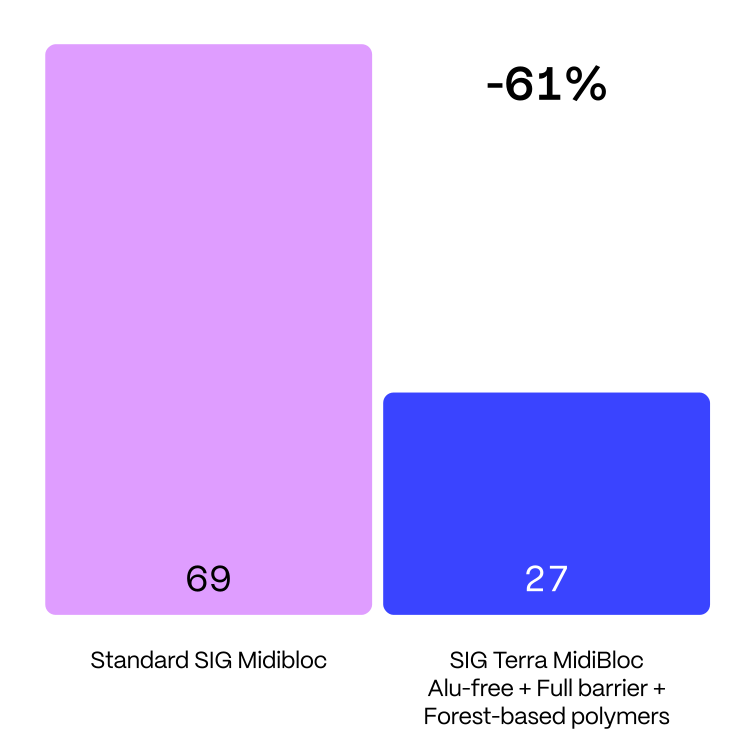
The already low carbon footprint of our aseptic cartons is reduced by up to 61%16 when linking SIG Terra Alu-free + Full barrier to renewable forest-based polymers9. While the aluminum makes up only around 5% of a standard aseptic carton, it accounts for about 25% of the carbon footprint in a full-barrier package. By replacing the aluminum with a lower energy-intensive alternative barrier material, it offers customers a powerful instant lever to achieve a significant reduction in their Scope 3 emissions and additionally supports our Climate+ commitment to Decarbonize our value chain.
Composed of up to 81% paper5, the SIG Terra Alu-free + Full barrier material simplifies the packaging structure down to only two main raw materials, with the potential to streamline the recycling process for aseptic cartons. By further simplifying the design, we also take an important step towards Recycling at scale globally, per our Resource+ commitment.
SIG Terra Alu-free + Full barrier is already available in single-serve format with SIG MiniBloc and in multi-serve with SIG MidiBloc, and we will expand to further formats going forward – enabling our customers and us to impact at scale across different pack sizes and product categories.
Each advancement brings us closer to realizing our vision of a packaging system that not only minimizes impact but actively regenerates resources and strengthens the circular economy – by furthering our material strategy to simplify structures, reduce reliance on finite resources and enable recycling at scale.
5 Sleeve without closure.
9 Polymers linked to tall oil, a wood residue from paper making via an independently certified mass balance system.
16 Based on life-cycle assessment using the ISO 14040 and ISO 14044 international standards and critically reviewed by an independent expert panel for an aseptic carton CB-100740 for Europe.
Life-cycle carbon footprint: additional savings with SIG Terra Alu-free + Full barrier + Forest-based polymer solutions for aseptic cartons
kg CO2 equivalent per packaging required for 1,000 liters of milk or juice in 1 liter SIG MidiBloc with SIG SwiftCap Linked/Linked LP1
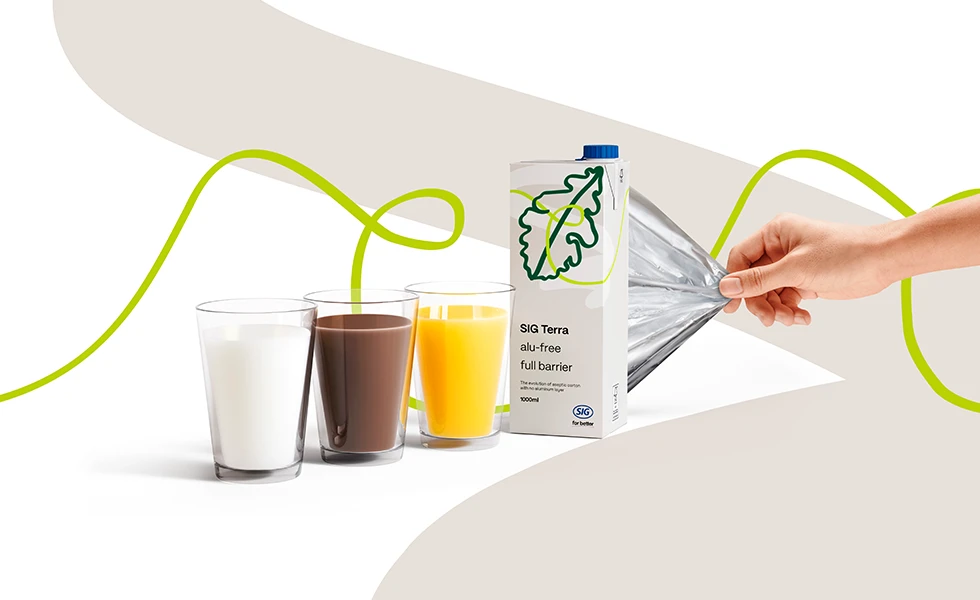
World’s first alu layer-free full barrier solution for multi-serve aseptic cartons – and first in juice
After the successful launch in single-serve packs in 2023 with China’s leading dairies Yili and Mengniu, we have expanded SIG Terra Alu-free + Full barrier into the juice category and a multi-serve format for the first time.
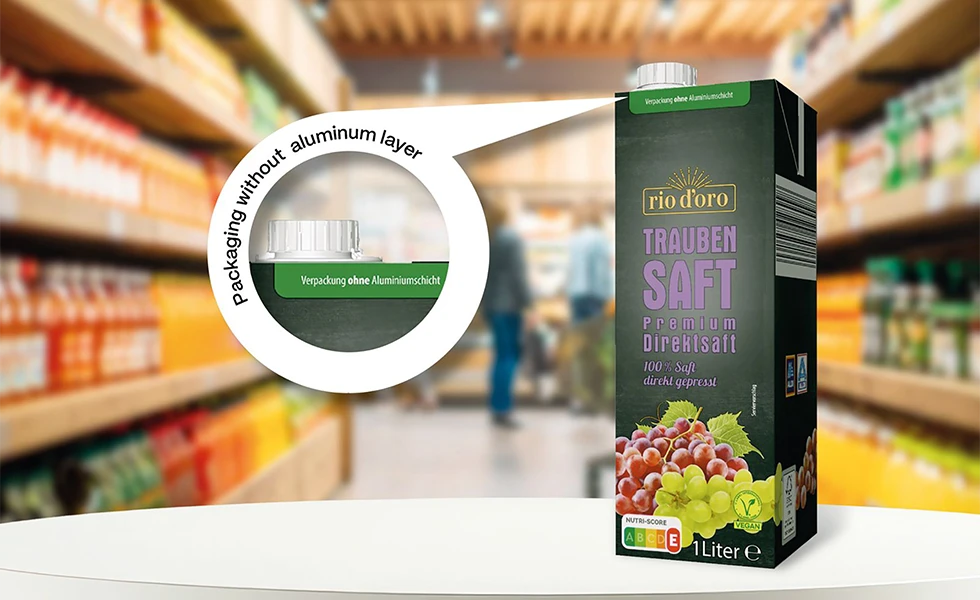
ALDI was the first to launch juice in SIG Terra MidiBloc Alu-free + Full barrier – Rio d’oro grape juice, filled by Quargentan – and the first to introduce SIG Terra Alu-free + Full barrier in Germany.
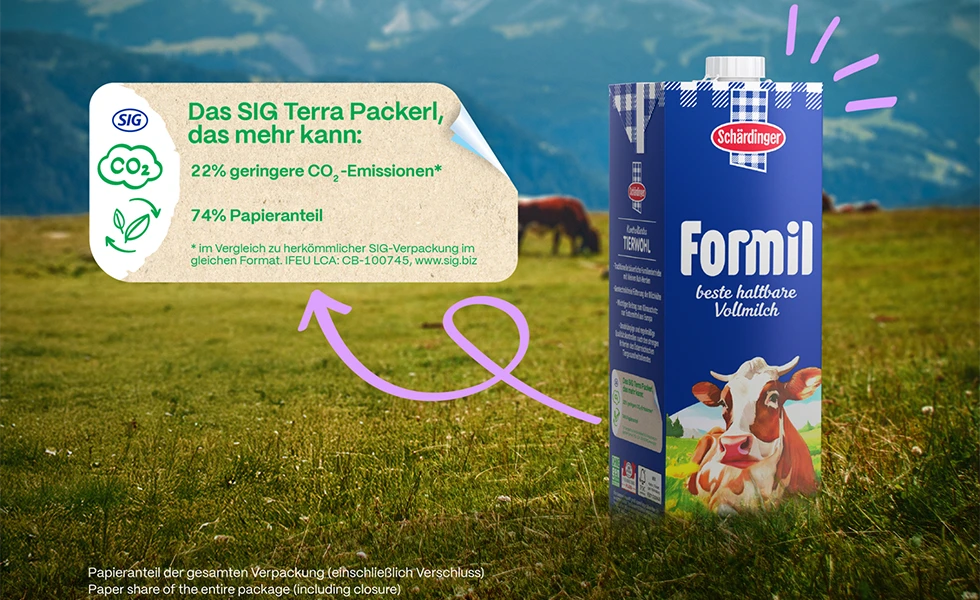
Berglandmilch, Austria’s leading dairy, was the first in Austria to adopt SIG Terra MidiBloc Alu-free + Full barrier, offering 1-liter aseptic carton packs for white milk under its premium brand “Schärdinger Formil.”
Enabling higher recycling rates in South Korea
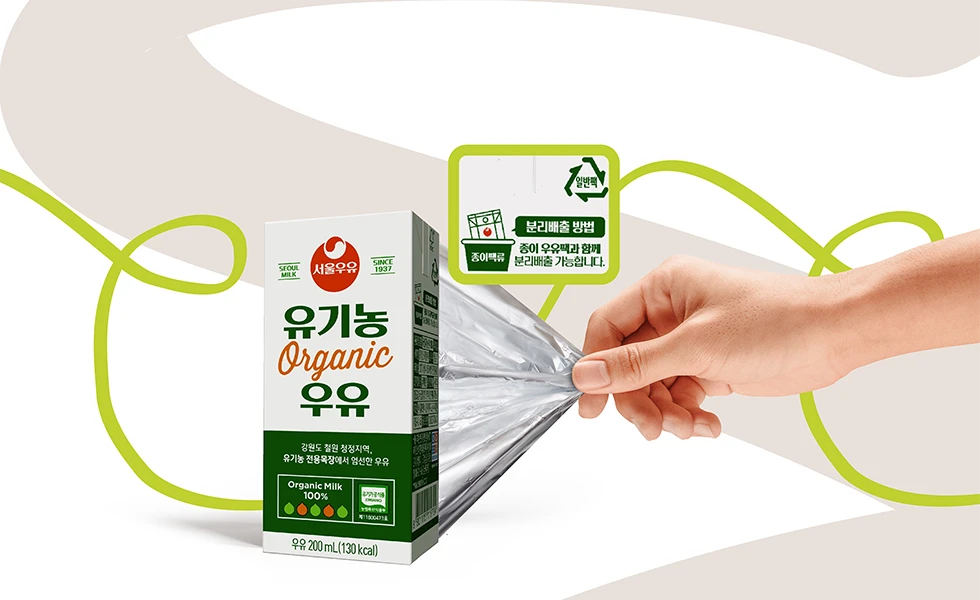
SIG set a new benchmark for sustainability in South Korea by launching SIG Terra Alu-free + Full barrier together with Seoul Dairy, bringing it to shelves as the first aseptic carton to comply with Korea’s recyclability grading system and receive a ‘Recyclable’ grade. Thanks to its simplified structure, with only two main materials to separate instead of three, brands can now use the official ‘Recyclable’ label, enabling significantly higher recycling rates in South Korea – up to ten times higher than conventional aseptic cartons15.
15 Based on recycling rates for aseptic carton packs and gable top cartons for chilled products in South Korea: http://www.kora.or.kr/epr/record.do