Resource+
From resource use to resource regeneration
Our journey toward a regenerative packaging system starts with how we source, design, and recover materials. With Resource+, we are advancing our material strategy to transform the life cycle of packaging – restoring nature, strengthening circularity, and ensuring our packaging contributes more to the planet than it takes, thereby also meeting customer demands for sustainable packaging solutions.
Our ambition is that all SIG packaging will be resource-positive by design: maximizing renewable content, accelerating material recovery, and driving innovation so materials remain in use through effective recycling pathways.
To achieve this, we will:
Prioritize renewable, forest-based materials.
Reduce dependence on fossil-based and finite resources.
Design for circularity so materials can be transformed into new products, preserving value beyond first use.
Collaborate across the value chain to scale collection and recycling in key markets.
Advance a just transition through inclusive partnerships and innovation.
Through this approach, our packaging will go beyond minimizing impact – it will actively contribute to regenerating natural systems, supporting resilient communities, and strengthening the circular economy.
Our commitments
We are transforming packaging from resource use to resource regeneration. Our commitments underpin our ambition for regenerative packaging systems that are resource-positive by design and inclusive by approach, advancing a just transition across the value chain.
Lead in renewability by further increasing the share of renewable materials in our packaging – raising paper content by reducing fossil-based resources – and by replacing finite inputs with responsibly sourced alternatives.
Design for recycling by simplifying material structures so every pack can be easily collected, separated and transformed into new products.
Recycle at scale by collaborating closely with industry partners, NGOs, governments, and communities to accelerate collection and recycling, eliminate packaging litter, and build the infrastructure and incentives that keep materials in use and out of nature.
Through Resource+, our material strategy focuses on these three essential shifts. By delivering them together, we will move beyond minimizing impact to creating regenerative packaging systems that strengthen ecosystems, empower communities, and unlock systemic change.
Our approach
Our journey toward regenerative packaging starts with rethinking our materials, innovating to decouple growth from finite resources while ensuring our packs are designed for a circular, nature-positive future.
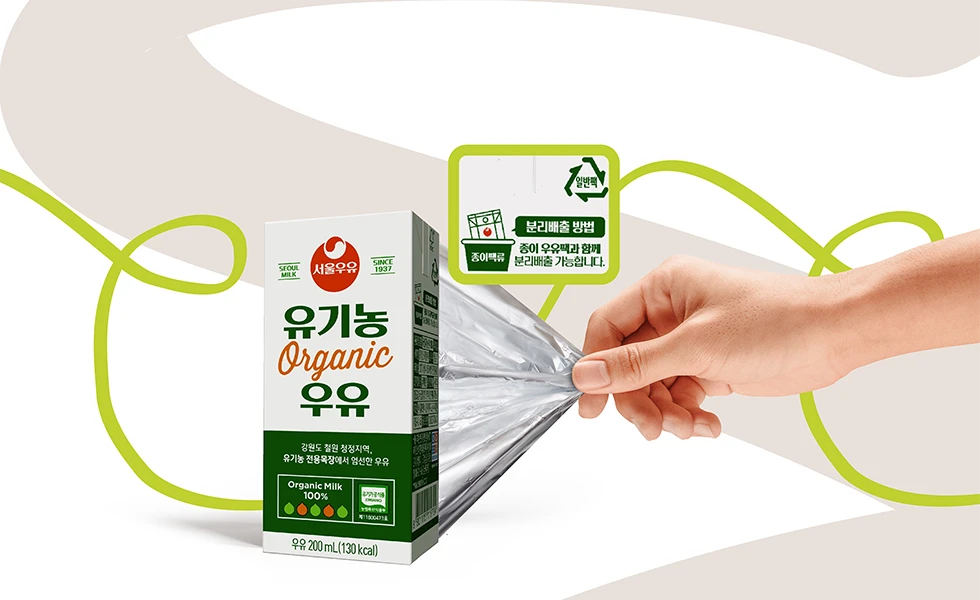
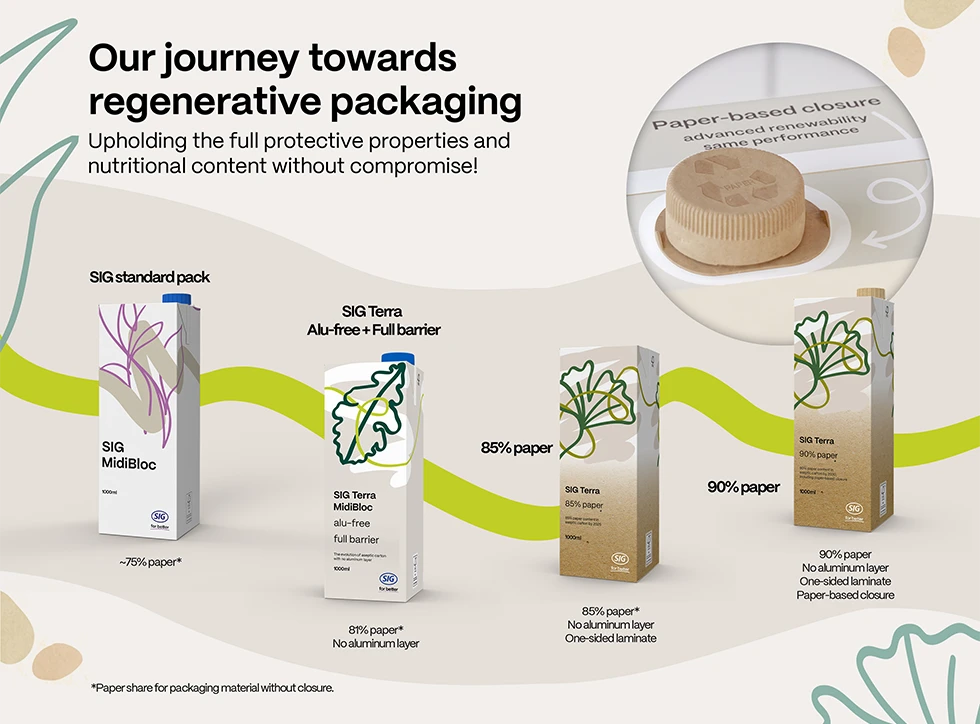
The first step on this journey is to phase out the aluminum layer. Removing the aluminum layer is a key innovation that simplifies recycling by eliminating the need to separate aluminum from polymers.
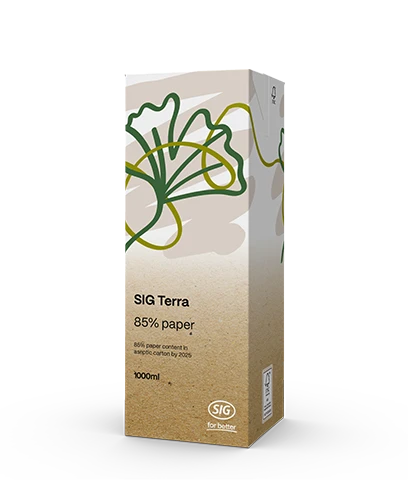
The next step in our regenerative packaging journey is to further increase paper share, reducing reliance on fossil-based materials. We have successfully conducted a feasibility test showing that our 85% paper-content carton (without closure) can be pulped in a standard paper mill. In the next two years we aim to commence an in-market pilot of the 85% paper content carton. This marks an important step toward the next milestone of achieving at least 90% paper content, including the closure by 2030.
Building on this further, transitioning from double-sided to single-sided lamination will significantly improve the pulpability of our cartons. This advancement will enable our future aseptic cartons to be recycled in standard paper mills – one of the world’s most established and efficient recycling systems.
Additionally, each step will contribute significantly to lowering the carbon footprint of our aseptic cartons even further, supporting our customers and our own efforts in Decarbonizing our value chain.
We aim for one in four aseptic cartons we sell to be aluminum-layer-free by 2030, representing a major step forward in expanding recycling opportunities and driving the transition to a more circular, low-carbon economy.
Measures taken and responsibilities
Leading in renewability
VP Global Research & Development
Leading in renewability reduces dependence on finite resources while strengthening the responsibly managed forests we source from. By simplifying the structure of our cartons, we can further cut the carbon footprint of our value chain, improve recyclability, and keep valuable materials in circulation.
Commence an in-market pilot of a full barrier aseptic carton with at least 85% paper content (without closure) in 2027
Develop a full barrier aseptic carton with at least 90% paper content (including closure), by 2030
Expand the use of certified recycled polymers, reaching a minimum of 10% recycled plastic content in all packaging sold in EU, by 2030
Develop a paper pouch for liquids, suitable for recycling, by 2030
Responsible sourcing, per our Nature+ commitment on A-materials1, is an important measure where we ensure:
Sourcing of our paperboard is 100% Forest Stewardship Council™ certified and includes the use of production residues and industry waste, such as wood chips (varies per paper mill – currently up to 36%).
We source 100% Aluminium Stewardship Initiative Certified aluminum foil, of which about 95% is linked to industry waste input.
For all our aseptic cartons, we offer a renewable forest-based or circular polymer solution, via the International Sustainability and Carbon Certification PLUS mass balance system.
Our plants purchase only plant-based ethanol for printing purposes, and we are working to transition to bio-based alternatives where we use fossil-based inks and solvents.
For all our packaging, including transport packaging, we continually research ways to introduce renewable or recycled alternatives to replace virgin fossil-based polymers.
Globally, we use corrugated cardboard as secondary packaging for our aseptic cartons, with 100% sourced from Forest Stewardship Council (FSC)™ certified suppliers across India, the Middle East, Africa, the Americas, Europe, and Asia Pacific (excluding China).
We work with customers to ensure that our filling machines, and their parts, are recycled or disposed of responsibly at end-of-life.
SIG is a project partner in developing a digital platform for designing renewable, sustainable lightweight composite materials based on wood fibers. The project, led by the University of Wuppertal and funded by the German Federal Ministry for Economic Affairs and Energy, focuses on integrating packaging requirements and sustainability criteria for resource-efficient material design.
For our aseptic carton filling machines, we provide guidance to our customers on target water and offer water reduction kits (see Nature+: Preventing pollution).
1 See Responsible culture: Our suppliers for our A-materials definition.
SIG and PulPac: Developing and scaling production of paper-based closures
SIG has entered a strategic partnership with PulPac, a global leader in Dry Molded Fiber technology. This collaboration aims to develop and scale up the production of fully paper-based closures – both base and cap – for SIG’s aseptic cartons. These closures will be designed to deliver the same functionality and performance as traditional plastic closures.
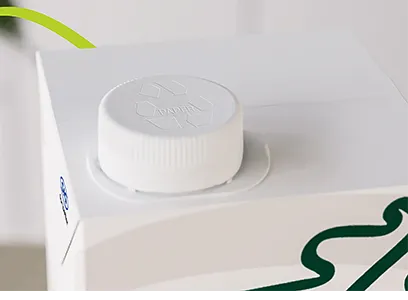
This innovation represents a potentially significant step toward achieving our target of at least 90% paper content, including the closure.
PulPac’s Dry Molded Fiber technology offers a renewable, resource-efficient alternative to plastic, using minimal water and delivering lower CO2 emissions. Designed for high-volume production, it also provides exceptional design flexibility. Thanks to SIG’s post-application technology, these closures can be seamlessly integrated into existing filling lines, enabling a “plug-and-play” solution without disrupting aseptic processes.
Designing for recycling
Director Group Corporate Responsibility
SIG cartons are already designed for recycling, and we also offer designed-for-recycling bag-in-box and spouted pouch alternatives for all our market segments. We are now going further by simplifying material structures to make recycling even more efficient.
Maintain all of our carton packaging as designed for recycling2
Offer a designed for recycling3 alternative for all our bag-in-box and spouted pouch market segments
25% of all our SIG aseptic cartons (by liters packed) will be alu-layer free, by 2030 (from 2026)
We continue to obtain independent recyclability certification of our standard beverage cartons, for our SIG Terra portfolio, which includes our SIG Terra Alu-free + Full barrier carton, and our designed for recycling bag-in-box and spouted pouch2.
The SIG Terra designed-for-recycling range of bag-in-box and spouted pouch solutions3 are being expanded to all our market segments with a focus on solutions that are made mostly from a single type of polymer (structure and fitment) to facilitate recycling, or have been proven to pass rigorous third-party testing.
SIG packaging innovations are evaluated for environmental impacts through robust life-cycle assessments (LCAs) carried out by a credible independent third parties, using the ISO 14040 and ISO 14044 international standards (see Appendix: Certifications) and critically reviewed by an independent expert panel.
We actively contribute to the development of industry standards that support packaging recyclability and circularity:
Participated in the creation of the 4evergreen Paper and Board – Recyclability Laboratory Test Method – Part III, enabling harmonized recyclability assessments for specialized recycling mills.
Contributed to the update of the Design for Recycling (DfR) guidelines to reinforce best practices in sustainable packaging.
Supported the European Committee for Standardisation (CEN) process to help establish protocols and guidelines as future EU standards in preparation for the Packaging and Packaging Waste Regulation (PPWR) delegated acts.
We provide continuous training for relevant SIG teams on our sustainable packaging design guidelines.
2 Our evaluation of recyclability of cartons is based on the relevant EN643 standard.
3 In line with Design for Recycling criteria developed by APR (Association of Plastic Recyclers), Recyclass and CEFLEX. Covers packaging sold as designed-for-recycling or for which such an option is available for the customer’s market segment.
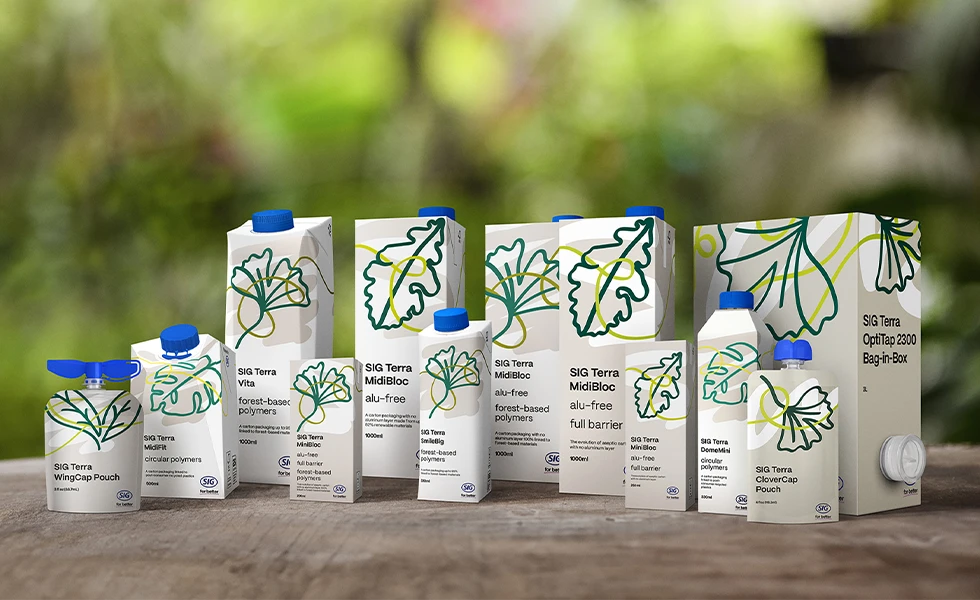
Sales of SIG Terra portfolio accelerate in 2025
SIG has packaged nearly 2 billion liters of food in SIG’s most sustainable packaging innovations, with double-digit growth in alu-layer-free aseptic cartons:
Sales of alu-layer-free aseptic cartons grew approximately 24% vs. 2024, demonstrating the unbroken increase in market demand for more sustainable packaging solutions without an aluminum layer. Since 2010, we have sold enough packs to fill more than 4 billion liters of food. In 2025, these solutions represented 4% of the liters of food packed in SIG aseptic cartons worldwide, and 9% in Europe.
Overall sales of our SIG Terra packaging materials for aseptic cartons grew more than 17% in 2025, driven by expansion in Europe of our range of alu-layer free packs and the global ramp-up of SIG Terra Alu-free + Full barrier – marking a milestone in SIG’s mission to drive sustainable innovation. SIG Terra solutions accounted for 11.3% of food packed in SIG aseptic cartons in Europe, where uptake has remained strong, and 5% globally.
Across our portfolio (including Bag-in-box and Spouted pouch), SIG Terra packs have filled more than 7 billion liters of food to date. This includes nearly 2 billion liters in 2025, or 6.7% of all food packed in SIG packaging worldwide, highlighting the growing preference for SIG’s even more sustainable offerings.
Recycling at scale
Director Group Corporate Responsibility
At SIG, we are dedicated to collaborating closely with industry partners, customers, policymakers, and communities to accelerate recycling at scale and eliminate packaging litter, ensuring that beverage cartons, spouted pouches, and bag-in-box packaging are collected, effectively recycled, and kept in circulation – not in nature.
Partner with stakeholders to maintain country-specific roadmaps to increase collection and recycling in priority markets covering over 90% of our global packaging volume (sales by weight), by 2030
Together with the industry, ensure all our packaging is recycled to at least 55% in Europe, by 2035
Our annual country-specific roadmap assessments review the local advocacy strategy to support regulatory developments, the steps needed to boost collection and recycling rates, and SIG flagship projects aimed at raising awareness and demonstrating best practices.
Close collaboration with pan-European and national associations helps strengthen Extended Producer Responsibility (EPR) implementation for beverage cartons across Europe, helping improve existing schemes and securing adequate funding for collection, sorting, and recycling.
We are part of national Producer Responsibility Organizations (PROs), industry associations, and other interest groups that seek to promote recycling for all our packaging solutions and across all our priority countries.
With European recycling capacity expected to triple to over 225,000 tons annually by 2030, we invest in advancing the recycling of PolyAl – the polymer and aluminum fractional by-product of beverage carton recycling – through partnerships with recyclers like Palurec in Germany and innovators such as Fych in Spain.
We foster local collection and raise consumer awareness to strengthen recycling systems in priority markets:
Establishing partnerships through our Going Circular roadmaps to improve collection rates and promote responsible recycling practices.
Carefully selecting and monitoring collection and recycling partners to avoid negative impacts, including adherence to human rights policies.
Exploring streamlined processes to enhance the efficiency of partner assessments and ensure alignment with our sustainability standards.
We work with global partners and industry bodies to actively monitor the development of new recycling technologies and independently developed facilities, while also collaborating to drive systemic change in recycling (see Appendix: Partnerships and memberships).
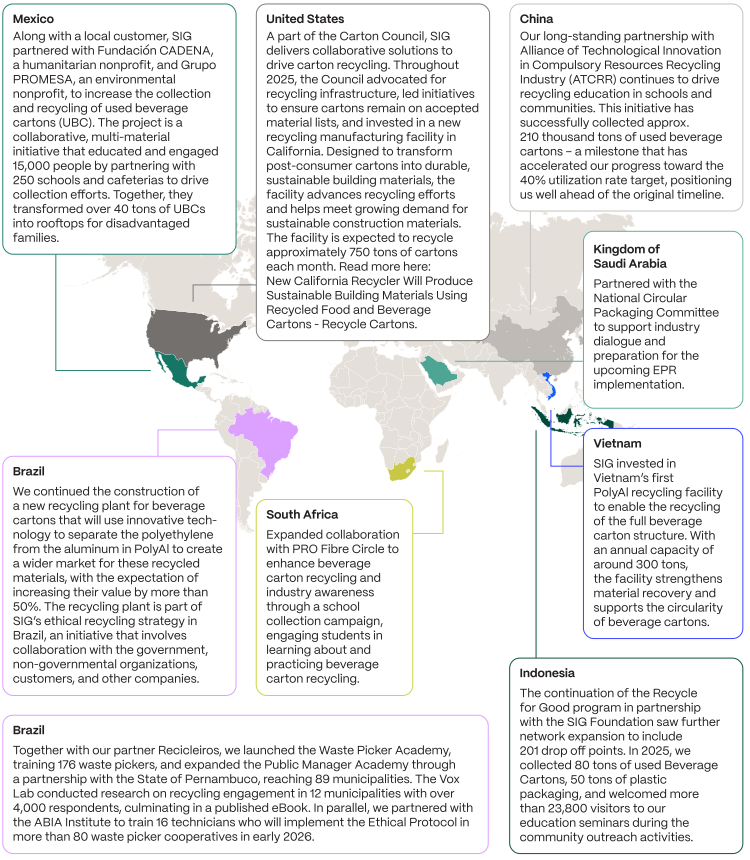
We are continuing our Recycle for Good initiative with a focus on used beverage cartons and spouted pouches (see Responsible culture: Communities).
Breakthrough: New one-sided lamination enables cartons to be recycled in standard paper mill
Recycling success proven in Indonesia
SIG has achieved a major breakthrough in circular packaging with the development of a full-barrier aseptic carton containing 85% paper. The new one-sided laminated structure was successfully tested at Eco Paper, a standard paper mill in Indonesia, confirming that it can be pulped and recycled just like paper and cardboard within their existing paper streams.
Two key innovation steps
The first key innovation is the removal of the aluminum layer, which fundamentally simplifies the delamination process in carton recycling. Conventional aseptic cartons require two steps: fiber recovery followed by separation of polymers from aluminum. Without the aluminum, only a single step is needed: fiber recovery in standard paper mills. This avoids aluminum residues in the pulp, reduces the carton’s carbon footprint, and allows the remaining polymers to be recycled through existing plastic systems.
The second step was to increase the paper content to 85% and move from double-sided to single-sided lamination. This structure reduced standard carton pulping time by half and increased fiber yield, producing more high-quality pulp per carton. It is also widely recognized that single-sided lamination is a fundamental requirement for enabling cartons to be processed in standard paper mills globally.
Impact
This innovation proves that SIG’s one-sided, full-barrier aseptic carton with 85% paper content can be efficiently processed in standard paper mills, unlocking access to one of the world’s most established recycling systems. It marks a significant step toward at least 90% paper content (with closure) by 2030 and supports the transition to a more circular, low-carbon packaging future.
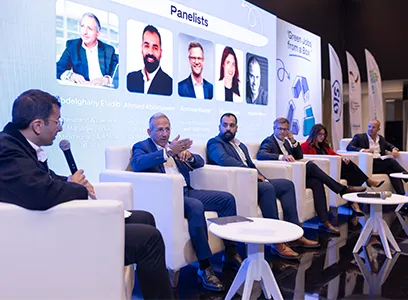
Green Jobs from a Box: Egypt’s first fully operational end-to-end beverage carton recycling system
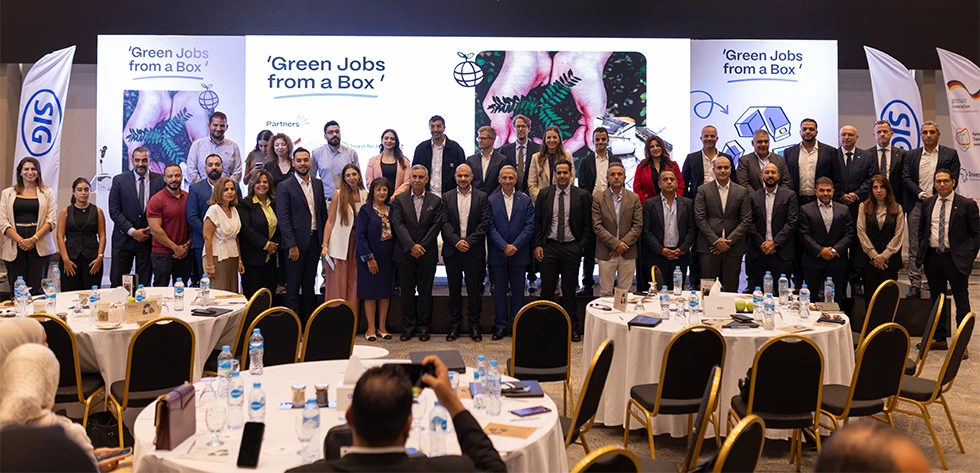
In September 2025, SIG, together with its partners Plastic Bank, GIZ Egypt, Carta Misr, and TileGreen, launched “Green Jobs from a Box”, Egypt’s first fully operational, closed-loop recycling system for used beverage cartons.
The initiative marked a regional milestone by recovering both paper fiber and PolyAl locally, while generating over 1,000 green jobs and empowering waste-collecting communities through traceable collection and inclusive infrastructure. A high-level event in Cairo brought together government officials, industry leaders, and media to celebrate the milestone and demonstrate the power of public–private collaboration in driving circularity and sustainable development. This pioneering model is now serving as a blueprint for scalable packaging recovery across the region.
From pack to purpose: Public-private action for packaging circularity in Egypt
On the left: Moderator Salem Massalha with Abdelghany Eladib, Ahmed Abdelaleem, Ghada Fouad, and Hussein El Masry
Below: Group photo of the launch event attended by government officials, diplomatic representatives, media representatives, key customers, and project partners including Plastic Bank, GIZ Egypt, Carta Misr, and TileGreen
Assessing effectiveness
In addition to the performance assessment of our Resource+ targets and Key performance indicators we assess the effectiveness of our policies and actions through the below reporting and monitoring by responsible parties:
Reporting |
|
Department |
|
Responsible |
|
Regularity |
|---|---|---|---|---|---|---|
Leading in renewability |
||||||
Key project status updates |
|
Global Marketing and Product Development |
|
Responsibility Steering Group |
|
Monthly |
Designing for recycling |
||||||
Key project status updates |
|
Group Corporate Responsibility |
|
Chief Technology Officer |
|
Annually |
Recycling at scale |
||||||
Country-specific roadmap assessments |
|
Regional Sustainability |
|
Group Corporate Responsibility |
|
Annually |
Our targets and performance
2020 to 2025 targets and performance
Target |
|
Material topics |
|
Progress tracker |
|
2025 performance |
|
Next steps |
||||||||
|---|---|---|---|---|---|---|---|---|---|---|---|---|---|---|---|---|
Develop a full barrier aseptic carton with at least 85% paper content (excluding closure) by 2025, and at least 90% paper content (including closure) by 2030 |
|
|
|
|
|
We have conducted a feasibility study for a full-barrier aseptic carton with 85% paper and one-sided lamination. The material proved recyclable in a standard paper mill in Indonesia, halving pulping time compared to standard beverage cartons. |
|
The 2025 target has been updated to reflect the commerical application of the product development, while the 90% target is retained in our Leading in renewability commitment. |
||||||||
Launch a full barrier carton with all main materials linked to renewable resources by 20251,2 |
|
|
|
|
|
The SIG Terra Alu-free + Full barrier + Forest-based polymers was commercially available in 2024, thereby achieving the target one year early. |
|
The completion of this target was an important step toward our regenerative packaging ambition. Our new targets to drive us further are found in our Leading in renewability commitment. |
||||||||
Offer a recycle-ready3 bag-in-box and spouted pouch solution in all our relevant market segments by 2025 |
|
|
|
|
|
Through innovations and recyclability testing since 2023, we have increased our offering of designed-for-recycling (previously “recycle ready”) solutions for bag-in-box and spouted pouch from 76% to 97%, covering all our relevant market segments. We have additionally received Association of Plastics Recyclers Design® for Recyclability Recognition for bag-in-box and spouted pouch solutions covering our major markets. |
|
The target has been reworded in line with the updated definitions of the Ellen McArthur Foundation and retained in our Designing for recycling commitment. |
||||||||
Partner with stakeholders to implement dedicated and country-specific roadmaps to support increased collection and recycling of beverage cartons, bag-in-box, and spouted pouches in priority countries that account for more than 90% of our global packaging sales (by weight) by 2025 |
|
|
|
|
|
We have Going Circular local roadmaps in priority countries that together account for 90% of our global packaging sales (by weight). |
|
Retained in our Recycling at scale commitment. |
||||||||
25% reduction in grams of waste per m2 of packaging material used to produce our aseptic cartons by 2025 (from 2016) |
|
|
|
|
|
Our waste rate reduced by 1.7% versus 2016. Since the target was set in 2020, our greenfield expansion of three aseptic carton production plants has been a factor restricting our ability to impact the rate due to ramp-up activities. |
|
While we continue to pursue internal targets on production waste reduction, we are focusing on the material topics of waste in our value chain. |
||||||||
Zero landfill – all waste to be recycled or used as renewable biofuel by 2025 |
|
|
|
|
|
Our waste footprint has evolved since the target was set, as our portfolio expanded to include bag-in-box and spouted pouch formats, which introduced new waste streams not previously in scope. In addition, regulatory and market constraints in several countries limit the use of waste as biofuel because incineration for energy recovery is not a common or permitted practice. |
|
While we continue to pursue internal targets on production waste reduction, we are focusing on the material topics of waste in our value chain. |
||||||||
Maintain certification to ISO 14001:2015 at all production plants |
|
|
|
|
|
We maintained our global ISO 14001 certification in all plants. |
|
We will maintain existing ISO 14001 certification at all plants as a commitment in our EHS policy while we pursue the material environmental topics in our value chain. |
||||||||
|
||||||||||||||||


See Appendix: Key performance indicators for related key performance indicators.
2026 to 2030 targets
Target |
|
Material topics |
|
2025 performance |
||||||
|---|---|---|---|---|---|---|---|---|---|---|
Leading in renewability |
||||||||||
Commence an in-market pilot of a full barrier aseptic carton with at least 85% paper content (without closure) in 2027 |
|
|
|
We have conducted a feasibility study for a Full-barrier aseptic carton with 85% paper and one-sided lamination, proven recyclable in a standard paper mill in Indonesia, halving pulping time compared to standard beverage cartons. |
||||||
Develop a full barrier aseptic carton with at least 90% paper content (including closure), by 2030 |
|
|
||||||||
Develop a paper pouch for liquids, suitable for recycling, by 2030 |
|
|
Reporting from 2026 |
|||||||
Expand the use of certified recycled polymers, reaching a minimum of 10% recycled plastic content in all packaging sold in EU, by 2030 |
|
|
|
Reporting from 2026 |
||||||
Designing for recycling |
||||||||||
Maintain all of our carton packaging as designed for recycling1 |
|
|
|
Reporting from 2026 |
||||||
Offer a designed for recycling2 alternative for all our Bag-in-Box and Spouted Pouch market segments |
|
|
Through innovations and recyclability testing since 2023, we have increased our offering of designed-for-recycling solutions for bag-in-box and spouted pouch from 76% to 97%, covering all our relevant market segments. |
|||||||
25% of all our SIG aseptic cartons (by liters packed) will be alu-layer free, by 2030 |
|
|
|
Reporting from 2026 |
||||||
Recycling at scale |
||||||||||
Partner with stakeholders to maintain country-specific roadmaps in priority markets covering over 90% of our global packaging volume (sales by weight), by 2030 |
|
|
|
We have Going Circular local roadmaps in priority countries that together account for 90% of our global packaging sales (by weight). |
||||||
Together with the industry, ensure all our packaging categories are recycled to at least 55% in Europe, by 2035 |
|
|
Reporting from 2026 |
|||||||
|
||||||||||
See Appendix: Key performance indicators for related key performance indicators.
Recycling initiatives
Outlook
SIG will accelerate the transition toward regenerative packaging systems that are resource-positive by design.
A key priority is the global rollout of aluminum-layer-free aseptic cartons, expanding their availability across all market segments to advance renewable, low carbon packaging and simplify recycling. In parallel, we will deploy our designed-for-recycling bag-in-box and spouted pouch solutions to drive the shift toward mono-material packaging that keeps materials in circulation. At the same time, we will continue to increase the paper content of our cartons and expand the use of renewable and recycled polymers to further reduce dependence on fossil-based resources.
Alongside innovation, SIG will strengthen collection and recycling systems in all priority markets, covering over 90% of our global business, through collaboration, advocacy, and investment.
Together, these actions will accelerate our progress toward a truly circular economy that regenerates natural systems and preserves value for future generations.